
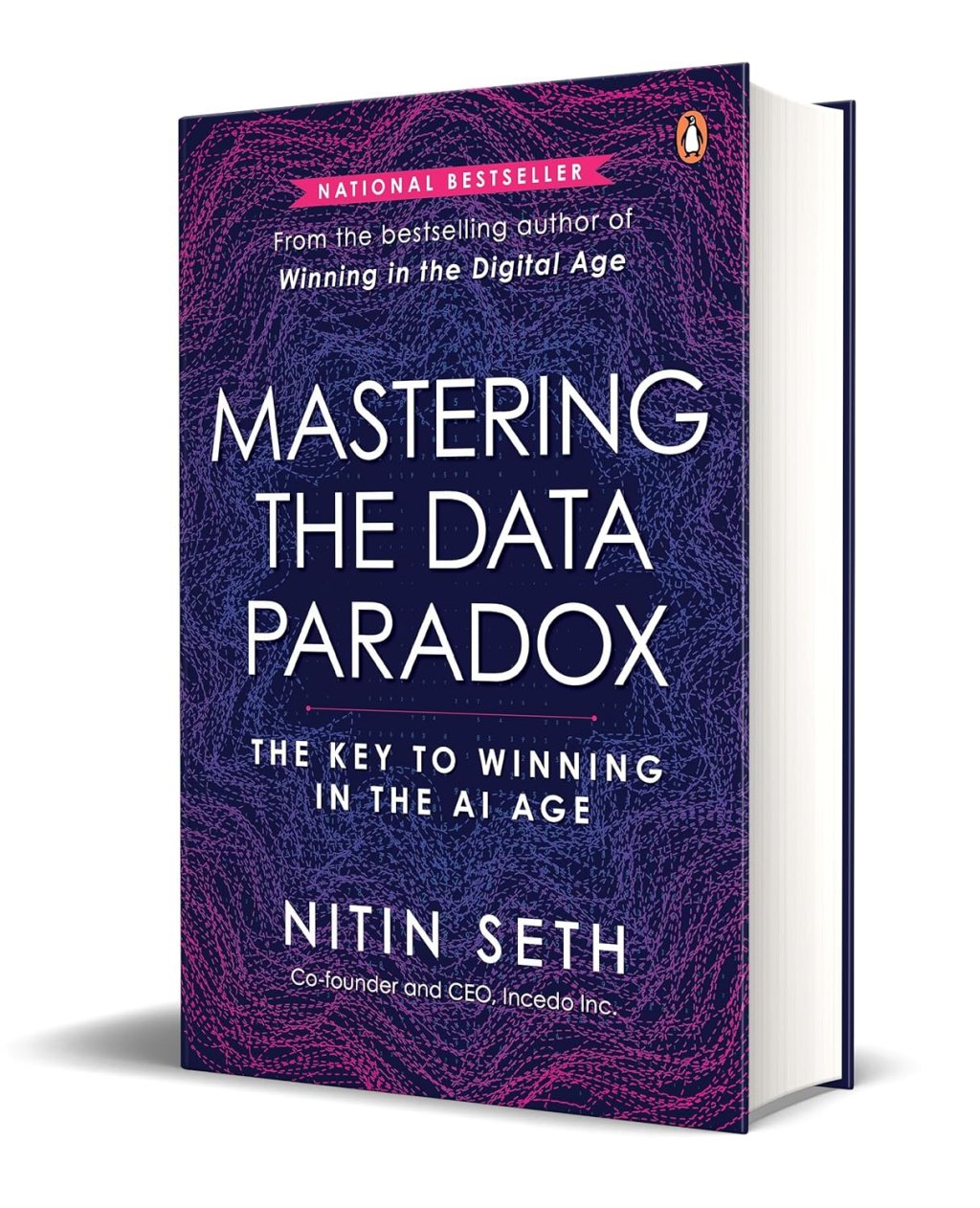
We are living through two revolutions at once. The first is the rise of a data-first world, where every interaction, transaction, and decision leaves behind a digital footprint. The second is the explosive emergence of artificial intelligence—particularly Generative AI—which has, for the first time, given us the ability to meaningfully interpret and leverage that data at scale. In Mastering the Data Paradox, Nitin Seth explores the powerful convergence of these two forces and offers a strategic roadmap for individuals and enterprises seeking to thrive in this new reality.
At the heart of the book lies a simple yet profound question: If data is so abundant, why do so many organizations still struggle to create value from it? This tension is what Seth calls the “data paradox.” Companies are drowning in information but starving for insight. They invest heavily in technology, yet fail to embed data meaningfully into their decision-making processes. Seth’s contribution is not merely diagnostic—he provides a structured, actionable framework to overcome this challenge.
A Shift in Mindset: Data as Strategy, Not Byproduct
One of the most compelling arguments in the book is the need to reframe how organizations perceive data. Seth urges leaders to stop viewing data as an operational byproduct and start recognizing it as a strategic asset. This shift demands more than technological upgrades—it requires cultural transformation.
He outlines a three-phase journey toward data democratization:
- The Planning Phase – Organizations must first understand their data ecosystems. This involves identifying data sources, mapping flows, and clarifying ownership and governance. Without this foundation, AI initiatives risk becoming fragmented experiments rather than scalable capabilities.
- The Enablement Phase – Seth advocates persona-based access and unlocking legacy systems to ensure data reaches the right people in the right format. The goal is to empower employees—not just data scientists—with usable insights.
- The Scaling-Up Phase – True transformation happens when data-driven practices are embedded into everyday workflows. Self-service analytics, visualization tools, and user-friendly platforms become catalysts for enterprise-wide adoption.
This structured approach makes the book particularly valuable for leaders overseeing digital transformation initiatives.
Data-Driven Decision-Making in Practice
Seth emphasizes that data-driven decision-making is not about replacing human intuition but refining it. In industries such as Healthcare and Life Sciences, this principle carries profound implications. Large datasets—from clinical trials, genomic sequencing, and patient records—hold immense potential. However, without disciplined analytics and governance, they remain underutilized.
Applying Seth’s framework could significantly enhance use cases such as revenue leakage analysis, drug return optimization, matching wholesale acquisition costs (WAC) to chargebacks, and detecting fraud in Medicaid or Medicare claims. His insights encourage organizations to move beyond descriptive analytics toward predictive and prescriptive intelligence.
What stands out is Seth’s insistence that AI is only as powerful as the data foundation supporting it. The promise of machine learning in drug discovery, disease outcome prediction, and treatment personalization can only be realized when data is accurate, accessible, and ethically governed.
Technology and the Human Edge
While the book is deeply rooted in technology, it never becomes technocratic. Seth maintains a balanced narrative: AI and advanced analytics platforms are enablers, not saviors. He cautions against blind faith in automation and stresses the enduring importance of human judgment, creativity, and ethical reasoning.
This human-centric lens distinguishes the book from many AI-focused business texts. Seth acknowledges that algorithms can identify patterns at unprecedented scale, but interpretation, accountability, and values remain uniquely human responsibilities. In doing so, he reframes AI not as a threat, but as an amplifier of human capability.
Ethics, Governance, and Trust
In an age marked by concerns about privacy breaches, algorithmic bias, and regulatory scrutiny, Seth devotes significant attention to ethical data use. He argues that governance is not merely a compliance requirement—it is a strategic imperative. Organizations that build trust through transparency, fairness, and responsible AI practices will earn long-term stakeholder confidence.
This perspective is particularly critical in sectors handling sensitive information. In life sciences and healthcare, for example, ethical lapses can have consequences far beyond financial penalties—they can erode public trust and compromise patient welfare. Seth’s emphasis on ethics provides a strong moral backbone to the book’s strategic guidance.
Real-World Relevance
Throughout the book, Seth integrates real-world examples and case studies that ground his arguments in practical reality. These stories demonstrate how organizations have successfully harnessed data to drive measurable outcomes—improving efficiency, fostering innovation, and gaining competitive advantage.
Rather than presenting abstract theory, he offers lessons that leaders can adapt to their own contexts. This pragmatic orientation enhances the book’s credibility and usability.
Perspective: Why This Book Matters Now
What makes Mastering the Data Paradox especially timely is the accelerating pace of AI adoption. Many enterprises are rushing to implement Generative AI solutions without addressing foundational data challenges. Seth’s message is clear: AI is not a shortcut to transformation. Without disciplined data strategy, AI initiatives risk becoming costly experiments.
From a broader perspective, the book also speaks to individuals. Professionals in every field must cultivate data literacy and adaptability. In the AI age, competitive advantage will belong not just to organizations with advanced tools, but to people who can interpret insights, ask better questions, and make informed decisions.
Final Verdict
Mastering the Data Paradox is more than a business book—it is a strategic manifesto for the AI era. Nitin Seth combines technological insight with human wisdom, offering a roadmap that is both visionary and practical. He challenges leaders to rethink their relationship with data, to democratize access, to prioritize ethics, and to embrace AI thoughtfully.
For executives, policymakers, technologists, and industry practitioners—especially in data-intensive sectors like healthcare and life sciences—this book provides clarity amid complexity. It does not promise easy answers, but it equips readers with a structured approach to navigating one of the most consequential shifts of our time.
In a world overflowing with data and brimming with AI potential, those who master the paradox will not merely adapt—they will lead.




 Bookshotsapp
Leave a comment