
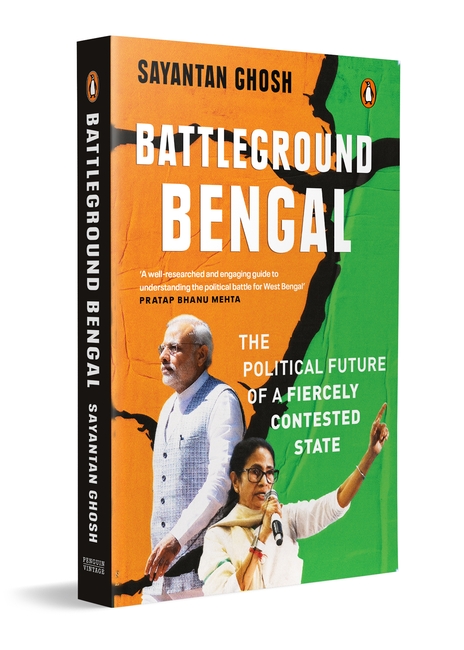
West Bengal has always staged its politics theatrically — on street corners, in para clubs, in university canteens, and in the charged silences of village courtyards. But in the decade since 2014, the script has been torn up and rewritten. In Battleground Bengal: The Political Future of a Fiercely Contested State, Sayantan Ghosh steps into this unsettled landscape with a reporter’s notebook and a researcher’s discipline, producing a book that feels less like commentary and more like a close audit of a state in flux.
From Baam to Ram: The Great Electoral Migration
The numbers alone tell a story dramatic enough to unsettle any complacency. The BJP’s vote share in Bengal rose from 17 per cent in 2014 to nearly 38 per cent a decade later. The Left — once the ideological anchor of the state — has shrunk to the margins, hovering in single digits. In several Hindu-majority booths, the BJP crossed 70 per cent; Muslim voters consolidated decisively behind the Trinamool Congress.
Bengal, long accustomed to dominant-party systems, is now locked in a stark bipolar contest. What Ghosh captures well is that this shift was not merely arithmetic. It was emotional and generational — a migration of loyalties from the familiar red to a rising saffron, driven by aspiration, resentment, and a search for political relevance.
Scams, Courts and the Question of Institutions
The shadow of the School Service Commission recruitment scam looms large over the book. Courts struck down over 25,000 appointments; in one segment alone, 381 illegal recruitments were identified and original records destroyed. Enforcement Directorate seizures worth more than ₹100 crore deepened the crisis of credibility.
Ghosh treats these episodes not as isolated scandals but as signs of institutional fatigue. Through court documents and investigative records, he builds a picture of governance under strain — where administrative breakdown feeds political anger, and legal verdicts reshape electoral narratives. Violence, too, is documented not as an aberration but as a recurring feature of post-election Bengal, embedded in the texture of competition.
The Mamata Paradox
And yet, here lies the book’s central tension: Mamata Banerjee endures.
After more than a decade in power, amid corruption allegations and visible anti-incumbency, she remains Bengal’s most popular leader. Ghosh resists simplistic explanations. He locates her resilience in a dense web of welfare schemes, the consolidation of women voters, minority support, and an instinctive ability to turn political attack into personal resistance.
In Bengal’s political culture — deeply emotive and personality-driven — Mamata is not merely a chief minister. She is a combatant. That distinction matters.
The BJP’s Moment of Reckoning
The BJP’s ascent has been undeniable. It has absorbed the space vacated by the Left and altered the state’s political geometry. But Ghosh is unsparing about its structural limits — factionalism, uneven organisational depth, and a lingering cultural distance between Bengal’s political idiom and the party’s central leadership.
Prime Minister Narendra Modi’s mass appeal travels far. Whether it can translate into durable, booth-level consolidation in Bengal remains uncertain. The 2026 election, the book argues, will test whether momentum can mature into power.
Identity, Belonging and the Battle of Narratives
One of the most compelling strands of the book dissects the clash between the TMC’s Bengali asmita and the BJP’s civilisational Hindutva narrative. This is not simply ideology versus ideology; it is belonging versus belonging.
The contest plays out differently across Kolkata’s middle-class neighbourhoods, border districts, and minority-dominated constituencies. Ghosh captures this variation without reducing it to cliché. The so-called “Bhadralok Dilemma” — the urban, educated voter caught between cultural pride and national momentum — adds another layer to the unfolding drama.
Why 2026 Is Different
Crucially, Battleground Bengal focuses on the years after the 2021 Assembly election — the period most likely to shape the next one. It tracks how central-agency probes, welfare recalibrations, and the Election Commission’s Special Intensive Review have influenced strategy and perception.
Rather than rehearse Bengal’s long political past, the book keeps its gaze fixed on the immediate horizon. It asks not who once dominated Bengal, but who can command it next.
An Audit, Not an Argument
What makes this book stand out is its refusal to cheer or condemn. It does something rarer: it examines. Claims are checked against court orders; rhetoric is weighed against electoral data.
In a political climate saturated with outrage and hyperbole, that restraint feels almost radical.
As 2026 approaches, Battleground Bengal reads less like a forecast and more like a diagnostic report on a democracy under pressure — vibrant, polarised, wounded, and fiercely alive.

 Bookshotsapp
Leave a comment