
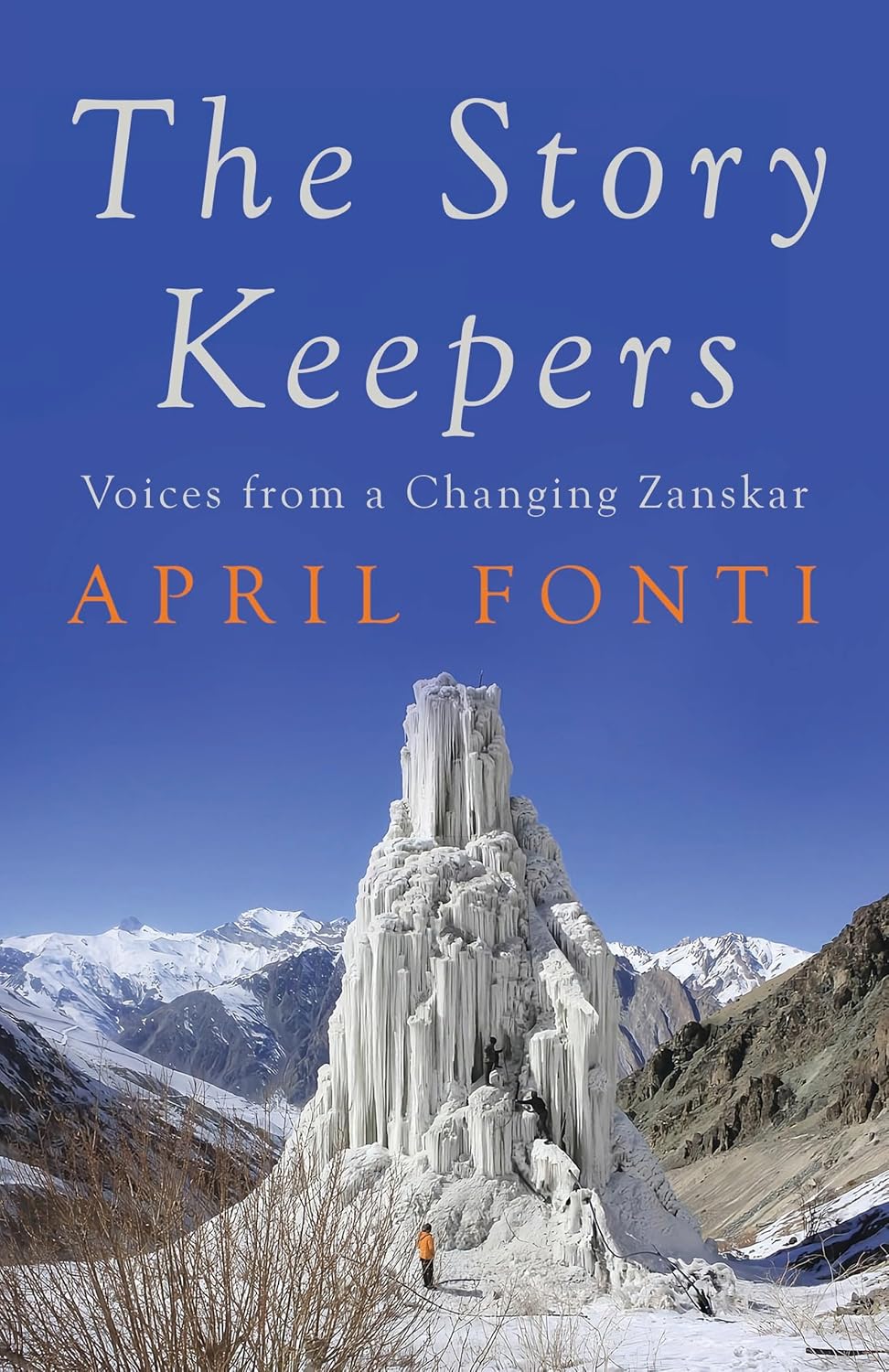
There are places in the world where time does not so much pass as settle—layer upon layer—into the mountains. Zanskar, cradled deep within the highest valleys of the Himalayas, is one such place. For centuries, this isolated Buddhist kingdom survived in one of the harshest climates on earth, sustained not by abundance but by balance: glacial streams coaxed into irrigation channels, herbs gathered from alpine slopes, garments stitched by hand, and lives shaped by restraint, ritual and an unshakeable belief in the unseen.
In The Story Keepers, April Fonti enters this rarefied world at the precise moment it begins to shift beneath its own feet.
In 1980, a road was built. It is a simple sentence, but in Zanskar it marked a civilisational turning point. Villagers who had never handled matchsticks soon encountered lighters, gas cylinders and electricity. Cash—once considered spiritually contaminating—flowed into daily life. Children who learned to write on slates would grow up scrolling on smartphones. Ancient Silk Road trails were replaced by asphalt arteries linking the valley to a restless, accelerating world.
Fonti first arrived in Zanskar in 2018, only to discover that the pre-industrial age was not distant history but living memory. Over the next six years, she returned repeatedly, gathering stories before they dissolved into nostalgia or silence. The result is not a conventional travel narrative, nor a romantic elegy for a “lost Shangri-La,” but a layered, intimate chronicle of transformation.
Her subjects are not abstractions but vivid presences: oracles who channel spirits in a modernising world; monks negotiating faith in the age of electricity; a runaway nun defying convention; the valley’s first nurse and postman navigating the fragile infrastructure of change; and the last two kings of Zanskar, custodians of a fading political order. Through their voices, Fonti reveals a society standing at a threshold—one foot anchored in myth and memory, the other tentatively stepping into global modernity.
What makes this book remarkable is its emotional and moral nuance. Fonti neither romanticises isolation nor celebrates development uncritically. The road brought medical access, education and mobility; it also introduced consumerism, social fragmentation and ecological strain. Climate change now unsettles the very glaciers that once guaranteed survival. The transformation is not a clean narrative of progress or loss, but a tangle of gains and griefs.
Fonti’s prose carries the clarity of a seasoned journalist and the lyric restraint of a careful observer. The stark Himalayan landscapes are rendered with photographic precision—wind-scoured plateaus, vertiginous passes, villages clinging to rock and sky. Yet the true landscape of the book is human: memory, belief, aspiration and doubt etched into lived experience.
The Story Keepers is, above all, an act of preservation. It captures voices poised between eras, ensuring that their stories endure even as the world around them accelerates. At a time when remote cultures are often flattened into myth or tourism, Fonti restores complexity and agency to Zanskar’s people. She shows us not a frozen relic of the past, but a thinking, adapting community negotiating its own future.
In doing so, she offers something far larger than a regional study. She asks universal questions: What does it mean to change within a single lifetime? How does a community reconcile spiritual cosmology with asphalt roads and digital screens? And what is the cost—material and metaphysical—of joining the modern world?
Expansive yet intimate, elegiac yet unsentimental, The Story Keepers stands as a major contribution to contemporary nonfiction. It is a book that listens deeply, writes carefully and lingers long after the final page—like the echo of footsteps across snow, carrying forward the voices of a world in transition.


 Bookshotsapp
Leave a comment