
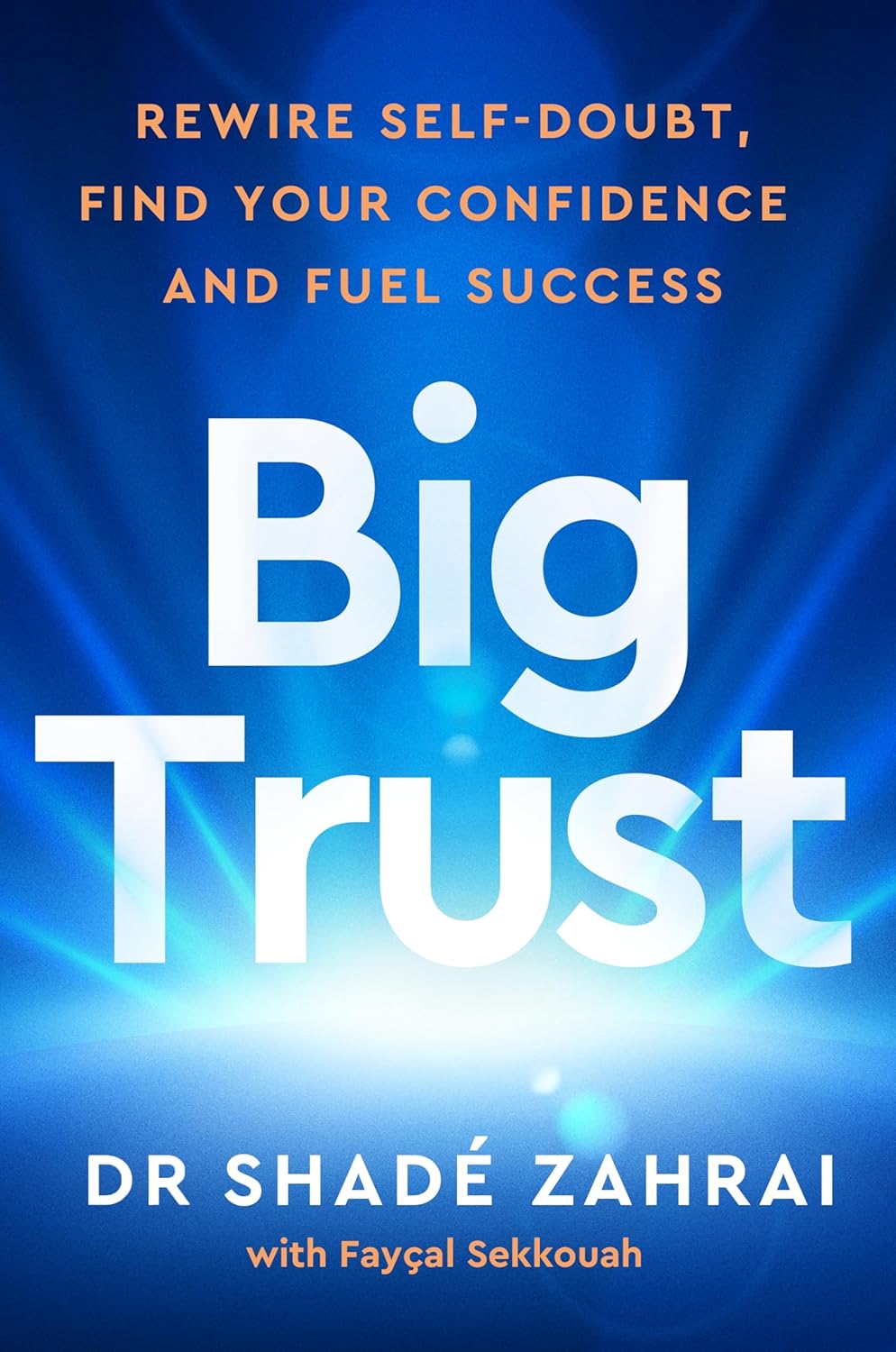
There’s a particular kind of doubt that doesn’t shout — it whispers. It shows up just before you hit “send” on an important email. It lingers after praise, convincing you it was luck. It questions you in high-stakes rooms where you’ve already earned your seat.
In Big Trust, Dr Shadé Zahrai turns directly toward that quiet saboteur — and instead of telling you to “push through” or “fake it till you make it,” she offers something far more sustainable: a way to build real, lasting self-trust.
This is not another hype-driven confidence manual. Zahrai, a behavioural researcher and former corporate lawyer turned peak performance educator, brings science and lived experience together in a way that feels grounded and deeply human. She understands high achievers — because she has worked with them for years — and she understands the paradox they often face: capability on the outside, second-guessing on the inside.
At the heart of the book is her practical and memorable framework — the Four A’s: Acceptance, Agency, Autonomy, and Adaptability.
- Acceptance teaches you to stop fighting your inner critic and start understanding it.
- Agency reminds you that you are not powerless in your own story.
- Autonomy helps you break free from people-pleasing and external validation.
- Adaptability equips you to stretch, grow, and face uncertainty without spiralling into self-doubt.
What makes Big Trust stand out is its balance. It is reflective but not indulgent. Scientific but not heavy. Motivating but not unrealistic. Zahrai doesn’t promise overnight transformation. Instead, she offers tools — self-diagnostic quizzes, practical exercises, and reframing techniques — that feel usable in real life.
You’ll find yourself recognising your own patterns: the perfectionism that masks fear, the comparison trap, the imposter thoughts that surface right before something meaningful. And instead of feeling exposed, you feel understood.
Perhaps the most powerful message in Big Trust is this: confidence is not something you chase. It’s something you build — decision by decision — by learning to back yourself, especially when it’s uncomfortable.
This book is particularly resonant for professionals navigating high-pressure environments, leaders stepping into larger roles, or anyone standing at the edge of a decision that matters. It speaks to the capable person who knows they can do more — if only they could quiet the doubt.
By the final chapters, Big Trust feels less like a performance guide and more like a steady hand on your shoulder. Zahrai doesn’t just explain how self-doubt works — she shows you how to work with it, and ultimately, beyond it.
In a world that constantly measures us, compares us, and tests us, Big Trust offers something quietly radical: the permission — and the method — to trust yourself fully.

 Bookshotsapp
Leave a comment