
Some poets belong to a language. Some belong to an era. And a rare few belong to a civilisation.
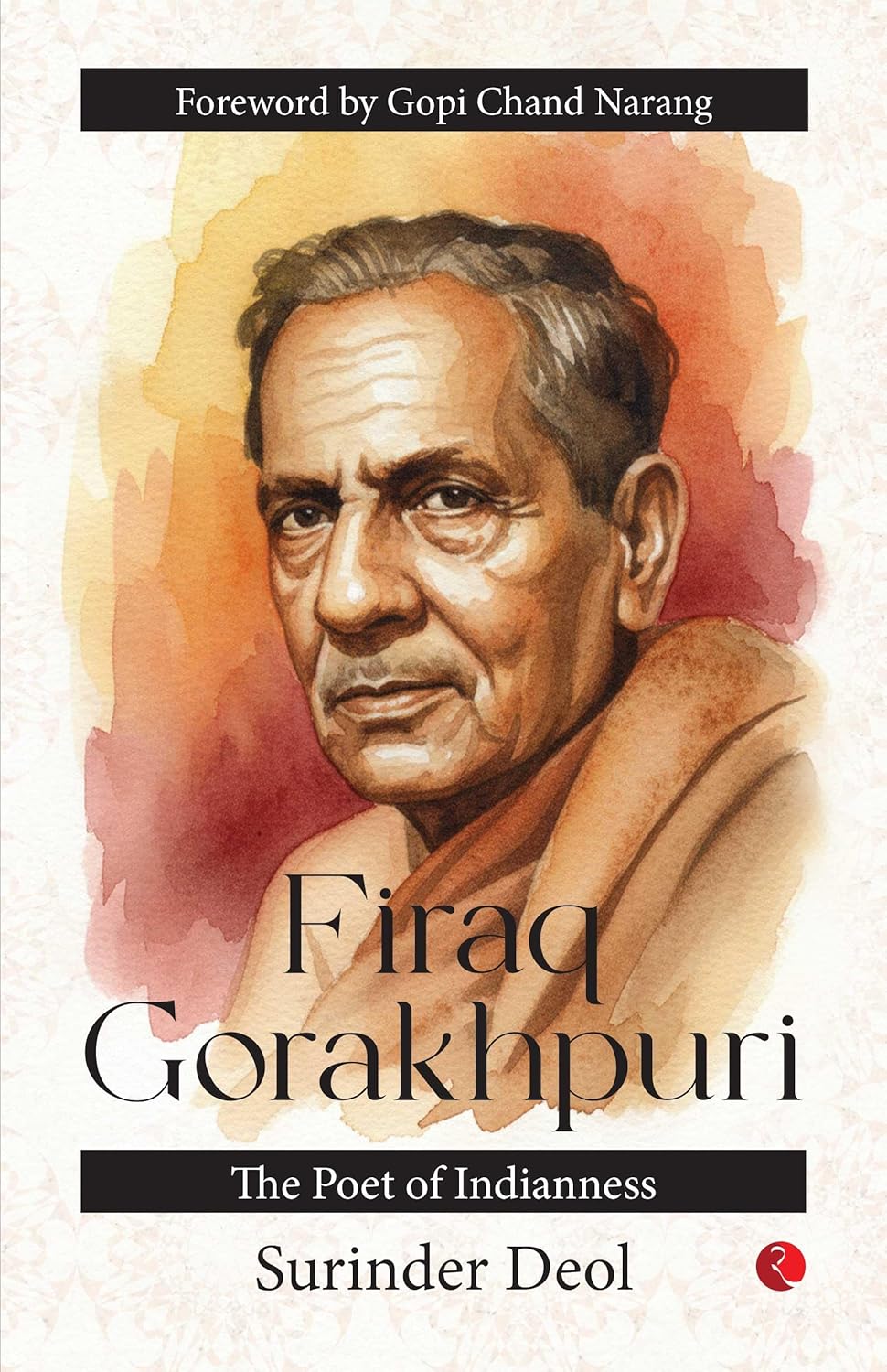
In Firaq Gorakhpuri: The Poet of Indianness, Surinder Deol approaches Firaq not merely as a master of the ghazal, but as a cultural force — a voice that insisted Urdu poetry could echo the full resonance of India’s civilizational soul. The result is not just a literary study, but a meditation on identity, belonging and artistic responsibility.
Firaq’s poetry has long been admired for its lush romanticism and aching lyricism. Love and longing ripple through his verses, yet they never feel confined to private sorrow. In Deol’s telling, Firaq emerges as a poet who expanded the emotional architecture of the ghazal. He retained its classical cadence — its elegance, its measured melancholy — but infused it with modern sensibility. The old wine was poured into a newly shaped cup.
What makes this portrait compelling is the intellectual breadth Deol foregrounds. Firaq was not a poet sealed within tradition. He drew deeply from English romantic poetry, absorbing its emotional intensity and individualism. At the same time, he remained attentive to the metaphysical nuances of ancient Sanskrit poetics — its layered symbolism, its philosophical quietude. Between these influences, he forged a distinctive idiom: sensuous yet reflective, intimate yet expansive.
Deol frames Firaq as a bridge — between East and West, feeling and thought, individuality and universality. This bridging was not aesthetic alone; it was civilizational. At the heart of Firaq’s work, Deol argues, lay a profound belief in India’s essential temperament — its gentleness, compassion and deep-rooted faith in the oneness of humanity. For Firaq, poetry was not ornamental. It was ethical.
One of the most striking aspects of this study is the emphasis on Firaq’s dissatisfaction. He believed Urdu poetry had not fully embraced the beauty and cultural depth of India itself. That absence troubled him. It became his mission to weave the soil, memory and moral imagination of India into the ghazal’s form. Through personal longing, he wrote of collective inheritance. Through romantic imagery, he gestured toward civilizational belonging.
Deol carefully traces how Firaq fused autobiography with national narrative. His poetry, in this rendering, becomes a mirror — reflecting not only love and desire, but patriotism and heritage. The beloved in Firaq’s verse often seems larger than an individual; she becomes landscape, memory, homeland. This layered symbolism gives his work a quiet gravitas that endures beyond its immediate lyric beauty.
The tone of Deol’s writing matches his subject. As a poet, author and translator himself, he approaches Firaq with sensitivity rather than distance. His prose does not flatten the poet into summary; it allows space for nuance and texture. There is admiration here, certainly, but also thoughtful interpretation. Deol invites readers to understand not just what Firaq wrote, but why he wrote as he did.
Importantly, this book situates Firaq within a larger conversation about cultural identity. In calling him “The Poet of Indianness,” Deol is not reducing him to a slogan. Instead, he highlights how Firaq’s commitment to India’s civilizational ethos shaped both his aesthetics and his philosophy. The ghazal, under Firaq’s pen, became capacious enough to hold the fragrance of Indian soil, the ache of separation, and the hope of unity.
For readers new to Firaq, this book offers an accessible yet layered entry point. For those already familiar with his work, it provides fresh angles — illuminating the crosscurrents of influence that made his voice so singular. Either way, it serves as a reminder that poetry is never written in isolation. It is shaped by language, by history, by longing, by land.
In Surinder Deol’s hands, Firaq Gorakhpuri stands revealed as more than a celebrated Urdu poet. He appears as an interpreter of India’s inner music — a craftsman of words who believed that beauty, compassion and unity were not abstract ideals, but lived truths waiting to be sung.
And sung they were — in verses that continue to shimmer long after the page is turned.
 Bookshotsapp
Leave a comment