
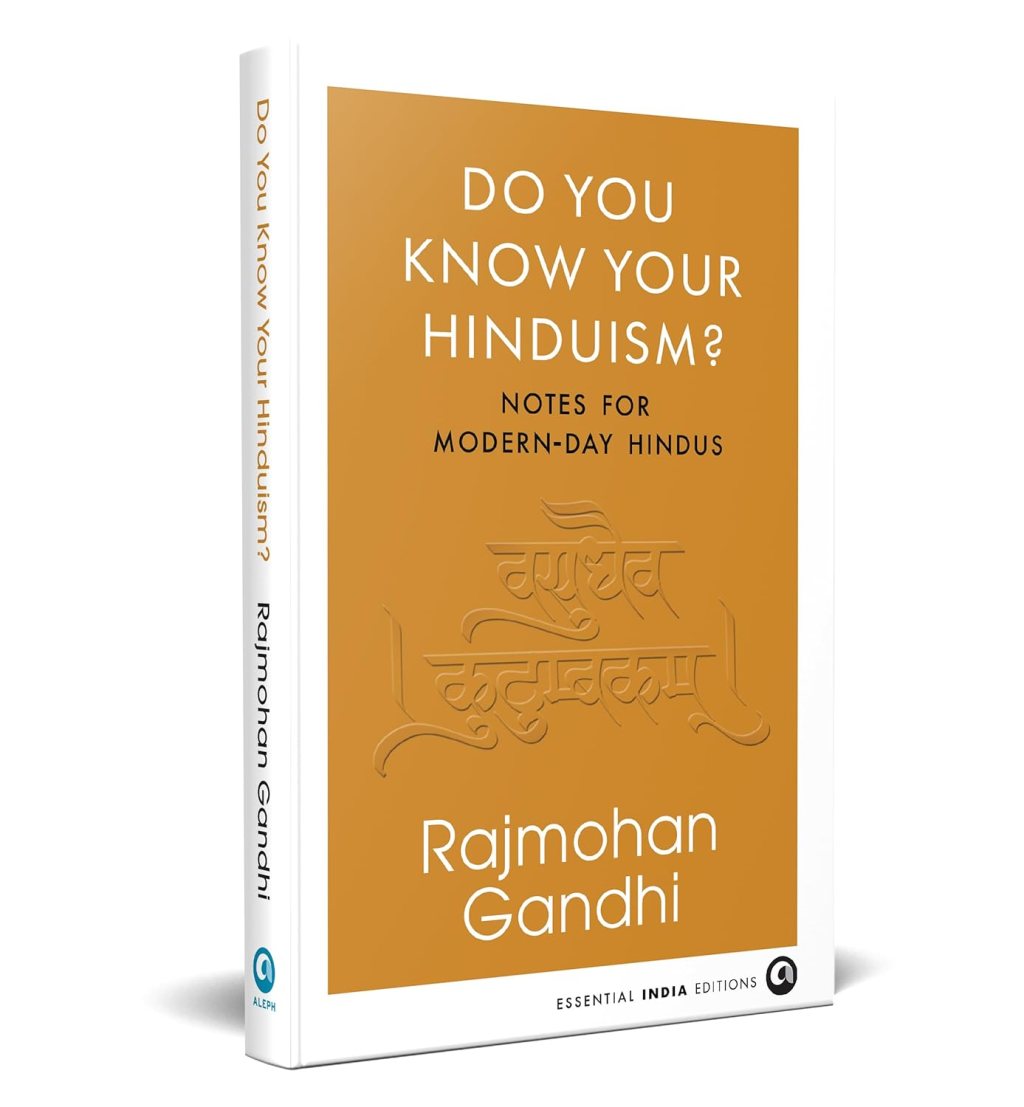
At a time when conversations about Hinduism often get caught in the crossfire of politics and identity debates, Rajmohan Gandhi’s Do You Know Your Hinduism? Notes for Modern-Day Hindus takes a calmer, more reflective route. Instead of offering a rigid definition of the faith, Gandhi invites readers to think about Hinduism as a living tradition—one that has grown through questioning, debate, and reinterpretation over centuries.
The book is relatively short, but the questions it raises are large. Gandhi looks at Hinduism not as a single, unified system but as a vast and evolving civilizational tradition. In his view, its strength lies precisely in its diversity—different ideas, philosophies, and practices existing side by side.
Throughout the book, Gandhi draws attention to phrases many people have heard since childhood but may never have paused to reflect on. Expressions such as Vasudhaiva Kutumbakam—the belief that the world is one family—and the Rigvedic line Ekam sat vipra bahudha vadanti—truth is one, the wise describe it in many ways—serve as examples of the pluralistic spirit he believes runs through Hindu thought. For Gandhi, these ideas are not just poetic lines; they reflect a deeper ethical outlook that has shaped the tradition for centuries.
One of the more thought-provoking ideas in the book is Gandhi’s attempt to treat “Hindu” less as a fixed religious identity and more as a set of values that guide how a person acts in the world. In other words, he suggests that being “Hindu” can sometimes function more like an adjective than a noun—something reflected in conduct rather than simply belonging to a community.
This interpretation, however, also drew debate when the book was discussed publicly. Scholar Ananya Vajpeyi pointed out that in today’s world, the word “Hindu” is most often used as a noun—referring to a community, temples, institutions, and even political ideas. Her observation highlights a larger tension the book touches upon: the gap between Hinduism as a broad philosophical tradition and the sharper identities created in modern politics.
Gandhi also reflects on figures he sees as moral voices within this tradition. Personalities such as Rabindranath Tagore, Raja Ram Mohan Roy, Mahatma Gandhi, and Vinoba Bhave appear in the narrative as thinkers who tried to connect religious belief with ethical responsibility and social reform.
During the discussion around the book, Gandhi recalled a gathering in 1948, shortly after Mahatma Gandhi’s assassination. Vinoba Bhave, speaking at the time, warned that blaming ideological opponents alone would not strengthen democracy. Even among those with different views, he said, there could be sincere and self-sacrificing individuals worthy of respect. By recounting such moments, Rajmohan Gandhi underlines the importance of dialogue and humility within public life.
At the same time, the absence of B.R. Ambedkar from the book’s list of key figures stands out. Ambedkar’s powerful critique of caste and Hindu social structures remains central to any discussion of the tradition today. When asked about this, Gandhi acknowledged the depth of Ambedkar’s arguments and the challenge they pose.
In the end, Do You Know Your Hinduism? reads less like a doctrinal guide and more like an invitation to reflect. Gandhi does not try to settle the question of what Hinduism ultimately is. Instead, he reminds readers that the tradition has always contained many voices, often disagreeing with one another.
In a public atmosphere where religion is frequently reduced to slogans or political labels, this small book encourages readers to return to something more thoughtful—the habit of asking questions about faith, ethics, and the values that shape society.
 Bookshotsapp
Leave a comment