
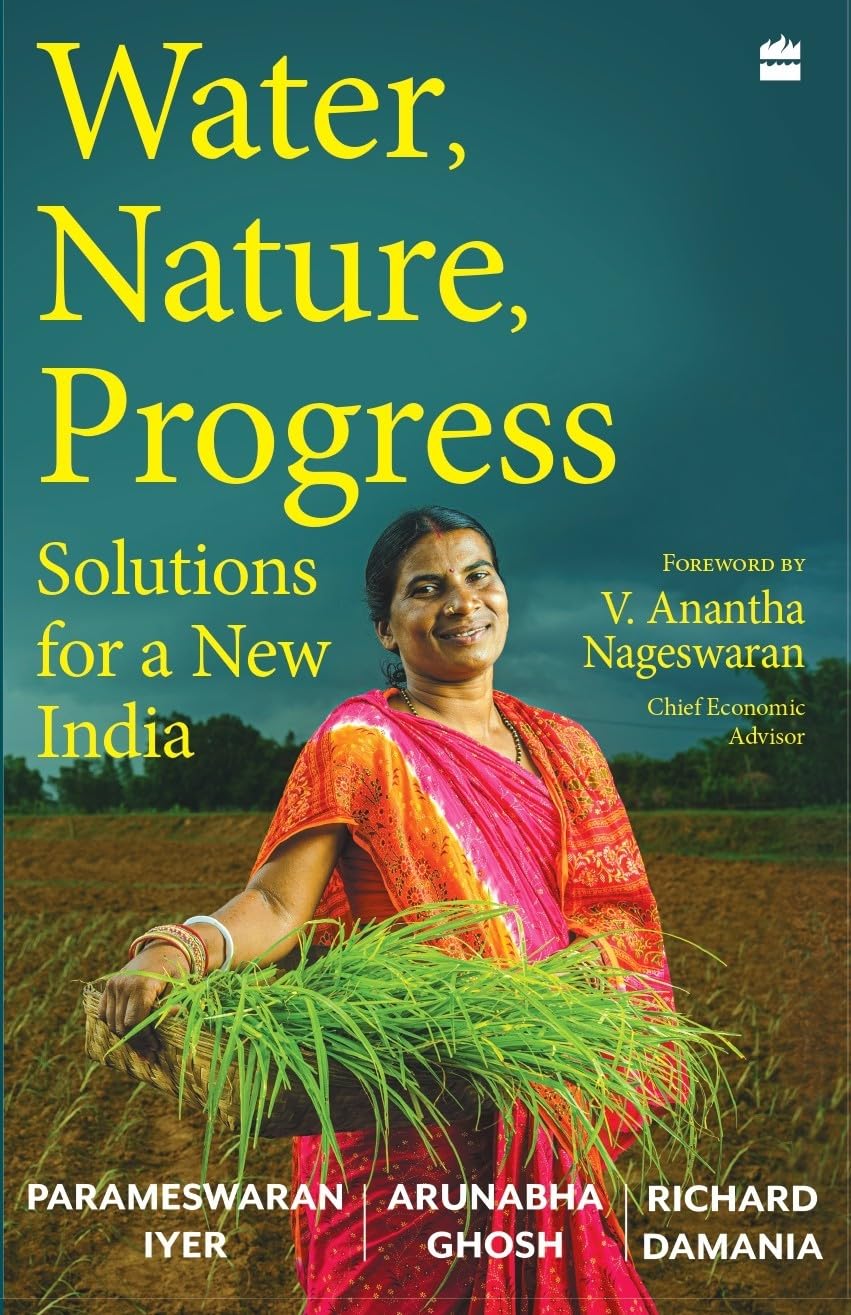
Marking World Water Day, a new book that takes a hard look at India’s deepening water crisis will be launched in the National capital, Delhi on March 22. Water, Nature, Progress: Solutions for a New India, authored by Arunabha Ghosh, Richard Damania and Parameswaran Iyer, brings together research, policy insight and on-ground experience to map both the scale of the problem and possible solutions.
The launch event, scheduled for 6 PM at the India International Centre (IIC), will feature a panel discussion with the authors, who will be joined by former Economic Affairs Secretary Anuradha Thakur, Chief Economic Adviser Dr V. Anantha Nageswaran, philanthropist Hari Menon and industry leader Jai Shroff. The conversation will be moderated by journalist Jayashree Nandi and is expected to focus on the urgent questions of water security, sustainability and development.
At the heart of the book is a stark reality: while India is home to nearly 18 per cent of the world’s population, it has access to just 4 per cent of global freshwater resources. This imbalance is beginning to show across sectors—from agriculture and industry to urban infrastructure and public health—making water management one of the country’s most pressing challenges.
The authors argue that water has not received the strategic attention it deserves, even as climate change, rapid urbanisation and unsustainable extraction push systems to the brink. Left unaddressed, they warn, water could emerge as a critical vulnerability in India’s growth story.
Drawing on extensive data, case studies and policy analysis, the book lays out a roadmap that goes beyond diagnosis. It calls for coordinated reforms spanning governance, public finance and private investment, alongside a shift in how water is valued and used. The emphasis is not just on scarcity, but on the possibility of turning water into a driver of sustainable economic transformation.
The discussion on March 22 is expected to reflect that broader ambition—moving the conversation from crisis to solutions, at a time when water is increasingly central to India’s future.


 Bookshotsapp
Leave a comment