
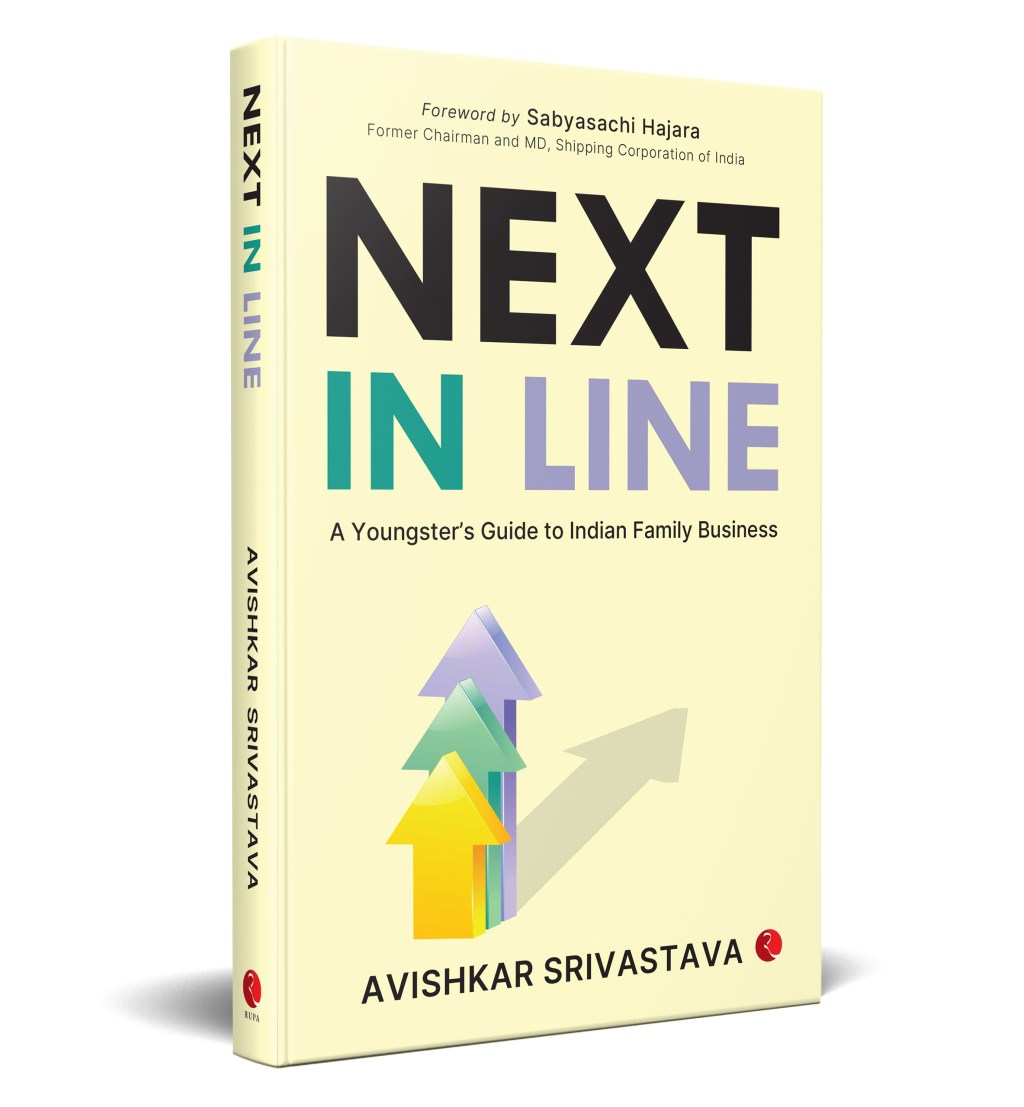
Family businesses are often seen as a blend of legacy, loyalty, and long-standing values—but beneath that surface lies a far more complex reality. Next in Line steps into this space with a grounded, insider’s perspective, offering a thoughtful guide for those preparing to inherit not just a business, but a delicate ecosystem of relationships, expectations, and responsibilities.
What makes this book stand out is its vantage point. It isn’t written from the distance of an academic observer or a corporate consultant. Instead, it speaks from within—the voice of someone who has stood at the intersection of tradition and transition. That immediacy gives the book a certain honesty. It doesn’t romanticize family businesses, nor does it reduce them to dysfunction. It acknowledges both their strength and their fragility.
At its core, the book is about clarity. Srivastava repeatedly returns to the idea that many of the challenges in family enterprises—conflict, stagnation, inefficiency—stem not from external competition, but from internal ambiguity. Undefined roles, blurred boundaries between personal and professional spaces, and decisions driven more by emotion than structure often hold businesses back. The author addresses these issues with a calm, practical tone, offering ways to introduce systems and accountability without disrupting family harmony.
One of the more compelling aspects of the book is how it balances structure with sensitivity. The push toward professionalization is not framed as a rejection of legacy, but as a way to protect and extend it. Whether discussing governance, workplace culture, or operational systems, the emphasis remains on evolution rather than overhaul. This makes the advice feel both realistic and applicable, especially in contexts where change can easily be met with resistance.
The sections on managing family dynamics are particularly nuanced. Instead of offering generic advice, the book recognizes the emotional undercurrents that shape decision-making in such environments. It suggests ways to bring in reason and clarity without dismissing the emotional investments that family members naturally carry. This balance—between logic and empathy—is one of the book’s strongest contributions.
Another notable strength is its focus on scalability. Srivastava doesn’t just address how to maintain a family business; he looks at how to grow it sustainably. The idea of “turning legacy into longevity” runs throughout the narrative, reinforcing the notion that inheritance is only the starting point. Building something that lasts requires intention, structure, and a willingness to adapt.
Because the insights are drawn from lived experience, they feel grounded rather than theoretical. The book avoids jargon and instead leans into practical, actionable ideas—whether it’s defining responsibilities, building systems, or fostering a more accountable work culture. This makes it accessible to young professionals who may not come from formal management backgrounds but are stepping into significant leadership roles.
Next in Line ultimately serves as both a mirror and a roadmap. For those already involved in family businesses, it reflects familiar challenges with clarity. For those preparing to step in, it offers a framework to do so with purpose. It doesn’t promise easy answers, but it does provide direction—something that is often more valuable.
In a landscape where most businesses are family-run but only a few endure across generations, this book feels timely and relevant. It makes a simple but important point: inheriting a business may be inevitable, but shaping its future is a choice—and that choice demands both discipline and understanding.

 Bookshotsapp
Leave a comment