
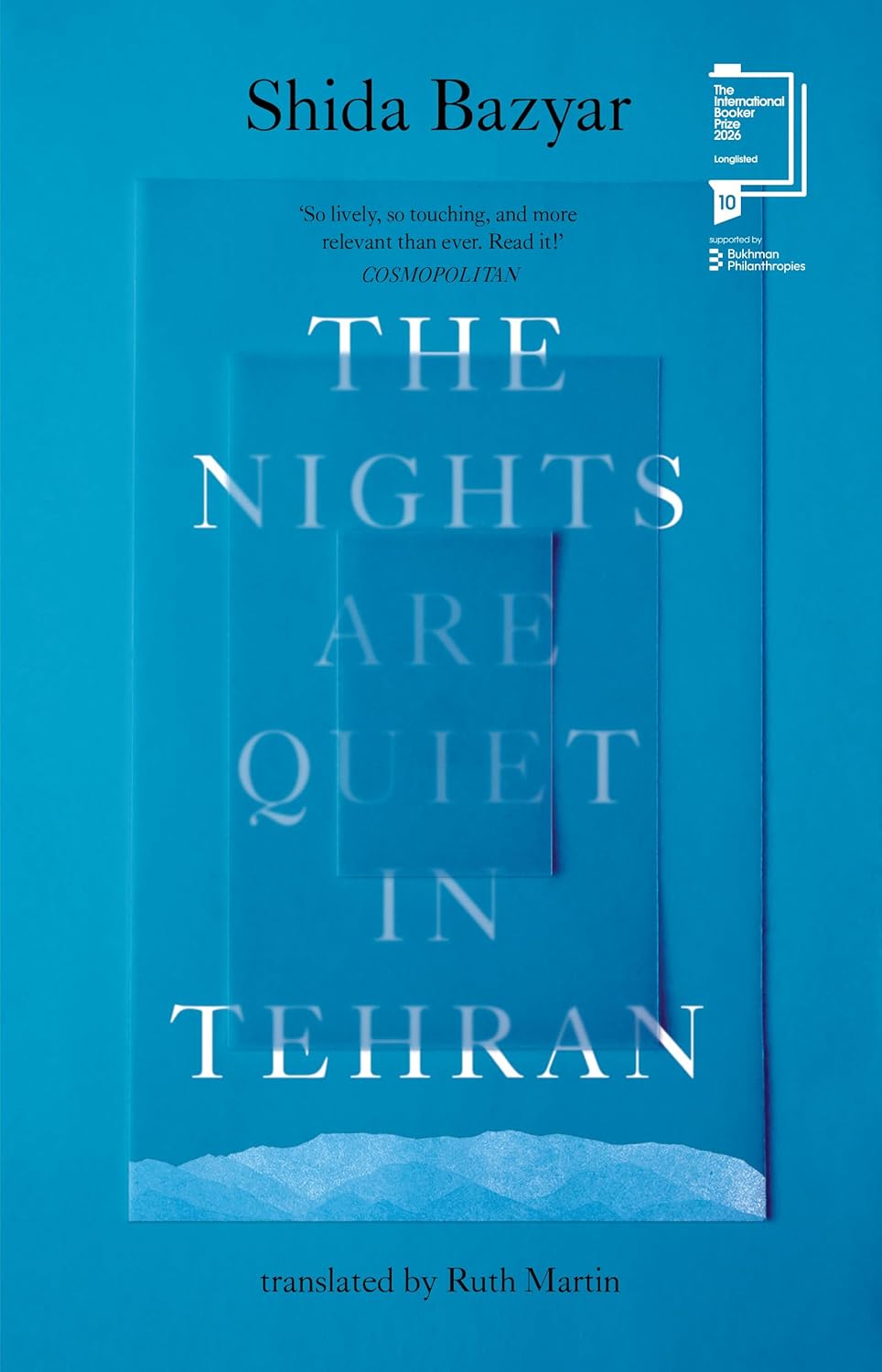
The Nights Are Quiet in Tehran by Shida Bazyar, translated by Ruth Martin, has been shortlisted for the International Booker Prize 2026, with the announcement made earlier this week.
The novel, a polyphonic family saga, follows an Iranian family across three decades—from the 1979 Revolution to the 2009 protests—tracing how political upheaval reshapes private lives long after headlines fade. Moving between Tehran and Germany, the book explores exile not as a single rupture, but as an ongoing condition that shapes identity, language, and generational memory.
Structured across multiple timelines, the narrative begins in 1979 with Behsad, a young communist revolutionary who takes part in the movement following the Shah’s expulsion, recounting political action and his relationship with Nahid. In 1989, Nahid and Behsad are living in West Germany with their children, closely following developments in Iran as others go into hiding.
The story then moves to 1999, when their daughter Laleh returns to Iran with her mother, encountering a Tehran that contrasts with her earlier memories. In 2009, her brother Mo navigates life in Germany as the Green Revolution in Iran unfolds, bringing renewed urgency to questions of politics and belonging.
Rather than revisiting major political events directly, the novel focuses on their aftereffects—examining how ideology enters domestic spaces, how silence can function as a survival strategy, and how trauma and unresolved questions are passed across generations.
At a time when conversations around protest, state power, and displacement are prominent globally, the book centres on the impact of political history on families, exploring how belief, fear, and hope evolve over time.
The International Booker Prize, one of the leading awards for translated fiction, continues to recognise works that connect geopolitical histories with lived experience. The winner of the 2026 prize will be announced on Tuesday, 19 May.



 Bookshotsapp
Leave a comment