
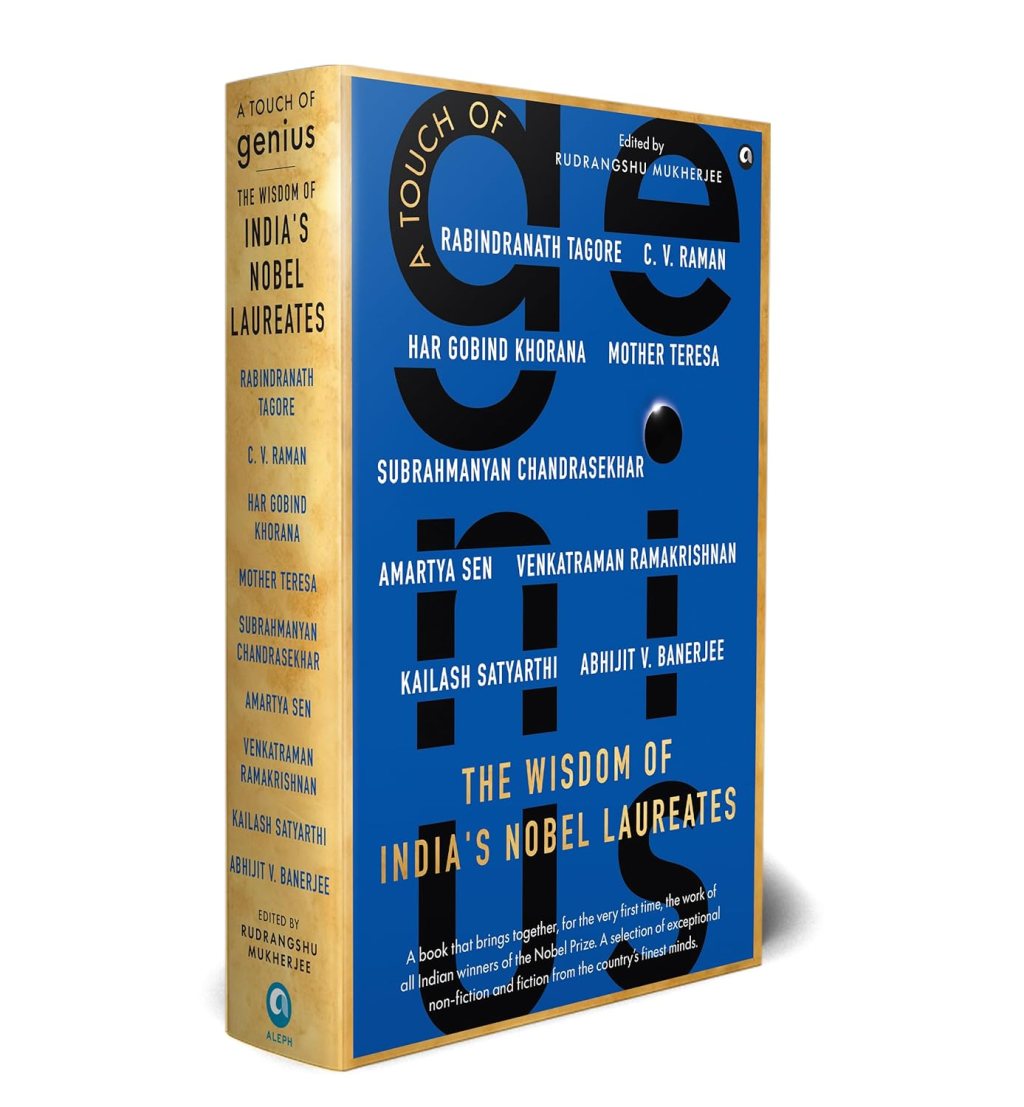
A Touch of Genius is not just a book—it feels like a conversation across time with some of the most brilliant minds connected to India. Carefully curated by historian Rudrangshu Mukherjee, this anthology brings together, for the very first time, the works of all Indian Nobel laureates—spanning literature, science, economics, and peace.
The book includes contributions from iconic figures such as Rabindranath Tagore, C. V. Raman, Har Gobind Khorana, Mother Teresa, Subrahmanyan Chandrasekhar, Amartya Sen, Venkatraman Ramakrishnan, Kailash Satyarthi, and Abhijit V. Banerjee. This diverse lineup itself makes the book unique—it is rare to find such a wide range of disciplines and perspectives in one volume.
The anthology contains over seventy pieces, including essays, short stories, poems, songs, and prayers. What makes it especially engaging is its thoughtful structure. The book is divided into ten sections—Memoir, Literature, Science, Economics, Religion and Philosophy, Aesthetics, Inequality and Injustice, Politics, India, and Nobel Lectures. Each section offers a different lens through which readers can understand the world.
The literary pieces, especially those by Tagore, are rich and reflective, filled with beauty and philosophical depth. In contrast, the scientific writings of figures like Raman and Chandrasekhar reveal the curiosity and discipline behind groundbreaking discoveries. The economic insights from Amartya Sen and Abhijit Banerjee stand out for their relevance even today, particularly in discussions around poverty and inequality. Banerjee’s work, especially his experimental approach to development economics using real-world data, shows how research can directly improve lives.

Equally powerful are the contributions of Kailash Satyarthi and Mother Teresa, which bring a deeply human and emotional dimension to the book. Their writings remind readers that compassion, dignity, and justice are as important as intellectual achievement. Satyarthi’s fight against child labour and his advocacy for education highlight the importance of social responsibility, while Mother Teresa’s reflections focus on service and humanity.
The scientific contributions of Venkatraman Ramakrishnan and Har Gobind Khorana add yet another layer, showing how Indian minds have contributed to global advancements in biology and chemistry. Their work reflects precision, innovation, and a deep commitment to discovery.
One of the strongest aspects of A Touch of Genius is how it connects all these voices through common themes—human struggle, curiosity, creativity, and the pursuit of a better world. Despite their different fields, all these laureates share a deep concern for humanity and a desire to understand and improve life.
About the editor, Rudrangshu Mukherjee’s academic background and experience add great credibility to the book. As a historian educated at institutions like the University of Oxford and associated with Ashoka University, he brings both scholarly depth and editorial clarity. His previous works on Indian history and figures like Gandhi and Tagore reflect his ability to present complex ideas in an accessible way, which is clearly visible in this anthology.
However, the book may feel slightly dense for some readers because of the wide range of topics and writing styles. Not every piece is easy to grasp on the first read, especially the more technical or philosophical ones. But this is also what makes the book rewarding—it encourages readers to revisit it multiple times.
In conclusion, A Touch of Genius is a rich and inspiring collection that celebrates the intellectual and moral contributions of India’s Nobel laureates. It is a book that educates, inspires, and challenges the reader to think deeply about the world. Whether you are interested in literature, science, economics, or social issues, this book offers something meaningful.



 Bookshotsapp
Leave a comment