
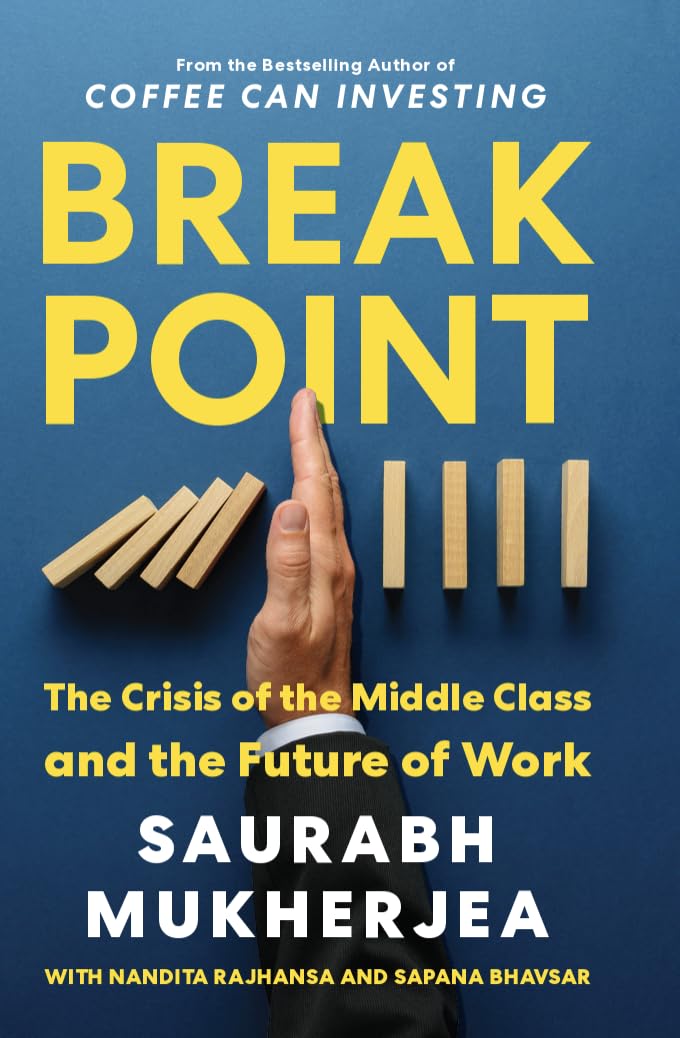
A new non-fiction title, Breakpoint: The Crisis of the Middle Class and the Future of Work, published by Juggernaut and written by Saurabh Mukherjea, with Nandita Rajhansa and Sapana Bhavsar, presents a stark assessment of the challenges facing India’s middle class, arguing that the country has reached a critical economic inflection point.
The book centres on India’s 40 million income-tax filers earning between ₹5 lakh and ₹1 crore annually, a segment that has historically driven the country’s consumption-led growth since the post-1991 economic reforms. According to the authors, this model is now under severe strain due to three simultaneous pressures: technological disruption reducing white-collar employment opportunities, wage stagnation amid rising inflation in essential goods and services, and sharply increasing household debt levels that now exceed those of the United States and China.
Drawing on extensive data, the authors highlight a range of economic stress indicators. Graduate unemployment is estimated at 29 per cent—significantly higher than among illiterate populations—while India’s IT sector is witnessing large-scale job losses as artificial intelligence reshapes the nature of work. Real wages have stagnated, and an estimated nine million Indians have collectively lost over $35 billion in speculative trading. At the same time, FMCG volume growth has declined sharply from 10 per cent to 3 per cent, raising concerns about weakening consumption, which accounts for 60 per cent of India’s GDP.
Rather than limiting itself to diagnosis, Breakpoint attempts to trace how these conditions emerged and what they could mean for the future. The book argues that beyond the visible economic slowdown lies a deeper structural shift affecting employment, aspirations, and financial behaviour within the middle class.
At the same time, the authors point to a potential turning point. Amid the pressures, they identify signs of an emerging entrepreneurial shift, supported by policy changes and evolving social attitudes, which could reshape the economic landscape. This dual narrative—of crisis and possible transformation—forms the core of the book’s argument.
Positioned as both a warning and a forward-looking analysis, Breakpoint frames the current moment as one of uncertainty for India’s middle class, raising a central question: whether the ongoing “middle-class mutiny” will lead to economic decline or a broader reconfiguration of work, opportunity, and growth.



 Bookshotsapp
Leave a comment