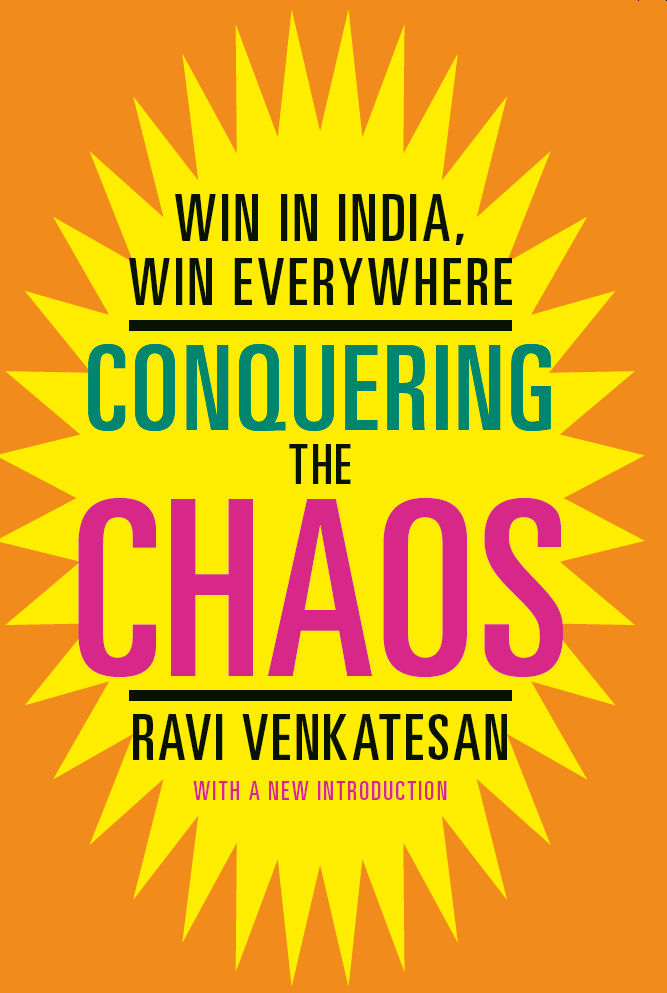
There are business books that offer formulas, and then there are books that force you to rethink the assumptions behind those formulas altogether. Conquering the Chaos falls firmly into the second category.
Ravi Venkatesan does not romanticise India’s business environment. In fact, one of the book’s strengths is how candidly it describes the realities of operating in a market shaped by bureaucracy, unpredictability, regulatory complexity, infrastructure gaps and constant adaptation. But rather than treating these as reasons to avoid India, Venkatesan flips the argument entirely: if a company can learn to succeed in India, it can probably succeed anywhere in the world.
What makes the book engaging is that it reads less like a management textbook and more like a reflection from someone who has spent decades navigating real business challenges at the highest level. Drawing from his experience leading companies such as Microsoft India and Cummins India, Venkatesan builds a larger argument about leadership, strategy and survival in volatile markets.
One of the most compelling ideas in the book is that many multinational corporations fail in India not because the opportunity is small, but because they approach the country with rigid global playbooks. The author repeatedly shows how companies underestimate the need for localisation, flexibility and speed. In India, strategies that work neatly in developed markets often collapse under the weight of local realities.
The book strongly argues against the “copy-paste” model of global business expansion. Instead, Venkatesan emphasises adaptability — not just in products, but in organisational culture, hiring, pricing, partnerships and decision-making. Companies that succeed are usually the ones willing to rethink their assumptions rather than force the market to adjust to them.
Another recurring theme is customer value. The book highlights how understanding what customers genuinely need — and what they can realistically afford — becomes critical in a price-sensitive and highly competitive environment. This is where the discussion around frugal innovation becomes especially relevant. Venkatesan explains how constraints often produce smarter, leaner and more scalable solutions, many of which eventually influence global business practices far beyond India.
What also stands out is the contrast the author draws between large corporations and entrepreneurial businesses. Large companies bring scale, expertise and resources, but often struggle with agility. Smaller firms may lack resources but compensate through responsiveness and a closer understanding of local markets. According to the book, the ideal organisation combines both — the discipline and capability of a global corporation with the flexibility and hunger of a start-up.
The book does spend considerable time on stories and context-building rather than hard data or detailed case-study analysis. Readers looking for charts, frameworks or quantitative models may find themselves wanting more evidence to support some of the broader conclusions. However, that does not weaken the central message. The strength of the book lies more in its strategic thinking and lived experience than in academic analysis.
What makes Conquering the Chaos particularly timely is the larger global backdrop against which it is written. With supply chains shifting, trade tensions rising and companies searching for alternatives in manufacturing and innovation, India is increasingly becoming central to global business strategy. Venkatesan argues convincingly that India is no longer just another emerging market; it is becoming a testing ground for leadership in an unpredictable world.
Perhaps the most lasting impact of the book is that it stays with you after reading. It pushes readers to question whether businesses are truly listening to markets or merely trying to impose familiar models onto unfamiliar realities. The book does not offer easy answers, but it does offer a sharper lens through which to understand growth, resilience and leadership.
Conquering the Chaos is ultimately less about India alone and more about learning how to operate in complexity. And in a world where volatility is becoming the norm rather than the exception, that may be its most valuable lesson.
