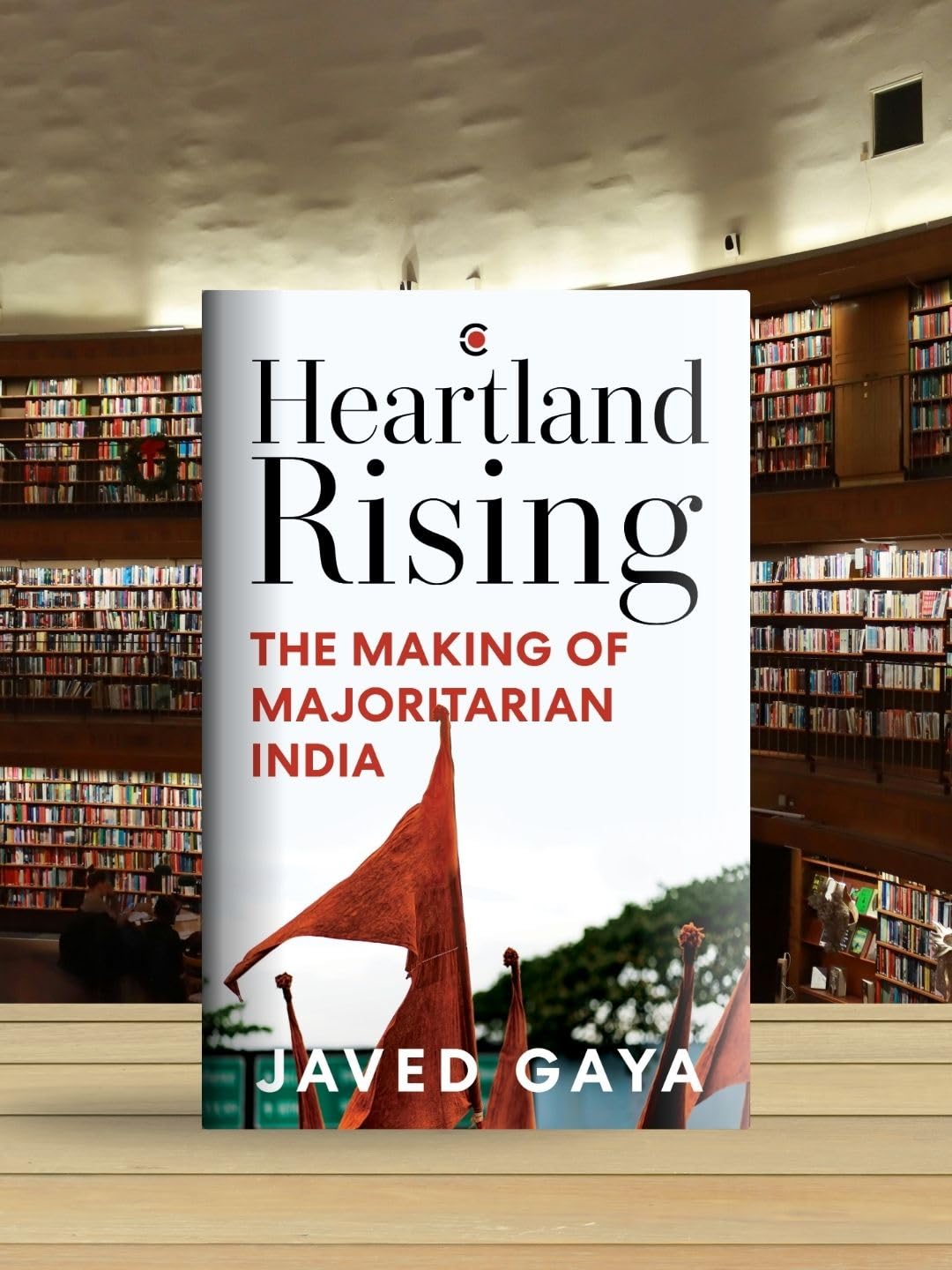
A provocative and deeply researched examination of India’s majoritarian turn. Few books attempt to tell the story of contemporary India by tracing a direct line from Partition and Constitution-making to the politics of the present. In Heartland Rising, lawyer and academic Javed Gaya does precisely that, offering an ambitious, provocative and meticulously argued account of how the foundations of the Indian republic have shaped the rise of majoritarian politics.
Published under Westland Books’ acclaimed Context imprint, Heartland Rising arrives at a moment when questions surrounding democracy, citizenship, federalism and minority rights have become central to India’s political conversation. It is not a neutral chronicle of events, nor does it aspire to be. Instead, Gaya presents a forceful argument that many of the crises confronting India today are rooted in choices made during the country’s formative years.
At the heart of the book lies a bold proposition: the Indian republic made a foundational mistake. Faced with a choice between liberty, understood as the principle of “one person, one vote”, and equality, understood as meaningful political representation for minorities within a robust federal structure, independent India chose the former. According to Gaya, that decision has had profound and lasting consequences.
The book argues that this constitutional preference gradually created the conditions for a majoritarian political order—one that has weakened institutional safeguards, narrowed the space for pluralism and undermined the democratic promise envisioned at Independence.
Gaya structures his narrative by moving between history and contemporary politics, tracing how the upheavals of the 1940s continue to reverberate through modern India. Partition is not treated as a closed chapter of history but as a transformative event that reshaped India’s political and social landscape for generations. He argues that the emergence and consolidation of the Hindi heartland as the country’s dominant political centre altered economic priorities, amplified caste and communal divisions and reconfigured the balance between the Centre and the states.
One of the book’s strengths is its willingness to interrogate institutions that are often considered guardians of constitutional democracy. Gaya pays particular attention to the judiciary, examining how landmark judgements and legal interpretations have, in his view, gradually weakened protections for minorities and facilitated the erosion of federal principles. The analysis is both detailed and unsettling, raising difficult questions about whether institutions designed to safeguard democratic values have inadvertently contributed to their weakening.
Throughout the book, Gaya repeatedly returns to the relationship between identity, citizenship and nationhood. He argues that contemporary India is increasingly being shaped by a narrowing definition of national identity, accompanied by a growing obsession with cultural purity, the mythologising of historical figures and the demonisation of minority communities. These developments, he suggests, are not isolated phenomena but the culmination of long-term political and constitutional processes.
What distinguishes Heartland Rising from many books on contemporary Indian politics is its interdisciplinary approach. Gaya draws from constitutional law, political theory, history and legal scholarship, creating a narrative that moves fluidly between academic analysis and accessible public writing. His background as a lawyer is evident throughout; arguments are presented with precision, evidence is carefully assembled and complex constitutional debates are explained with remarkable clarity.
The book’s greatest strength, however, is also what may make it contentious. Gaya does not shy away from taking strong positions. His central thesis—that the early republic’s choices were fundamentally flawed—will undoubtedly invite debate among historians, political scientists and constitutional scholars. Some readers may challenge his interpretation of liberty and equality as competing rather than complementary ideals. Others may question the extent to which contemporary developments can be traced back to constitutional decisions made in the late 1940s.
Yet disagreement does not diminish the book’s significance. If anything, it underscores its importance. Heartland Rising is not a book designed to provide comfortable answers; it is intended to provoke serious reflection about the trajectory of Indian democracy.
The book also serves as a warning. Gaya repeatedly suggests that India is approaching a critical juncture where democratic institutions, constitutional safeguards and federal structures are becoming increasingly fragile. The questions he raises are therefore not merely historical but existential: How does a diverse nation preserve pluralism in the face of majoritarian pressures? Can constitutional promises be renewed once institutional trust begins to erode? And what kind of republic does India aspire to become?
These are difficult questions, and Gaya offers no easy solutions. Instead, he asks readers to confront uncomfortable realities and reconsider assumptions that have long been taken for granted.
Stylistically, the book balances scholarly rigour with readability. It is dense in places, particularly when discussing constitutional debates and judicial interpretations, but the prose remains lucid and engaging throughout. Readers with an interest in political history, constitutional law and contemporary Indian affairs will find much to engage with.
More importantly, Heartland Rising contributes to a growing body of literature seeking to understand the deeper historical currents behind India’s present political moment. Rather than treating majoritarianism as a recent phenomenon, Gaya insists that it has a longer genealogy—one embedded within the very architecture of the modern Indian state.
Whether one ultimately agrees with his conclusions or not, his arguments demand serious attention.
At a time when democracies around the world are grappling with questions of identity, nationalism and institutional decline, Heartland Rising offers a timely and thought-provoking intervention. It is a book that refuses easy binaries and instead compels readers to engage with the complexities, contradictions and unfinished promises of the Indian republic.
Provocative, deeply researched and intellectually ambitious, Heartland Rising is an important contribution to contemporary debates on democracy, constitutionalism and the future of India. It is essential reading for anyone seeking to understand the historical roots of India’s majoritarian turn and the challenges confronting its democratic institutions.
