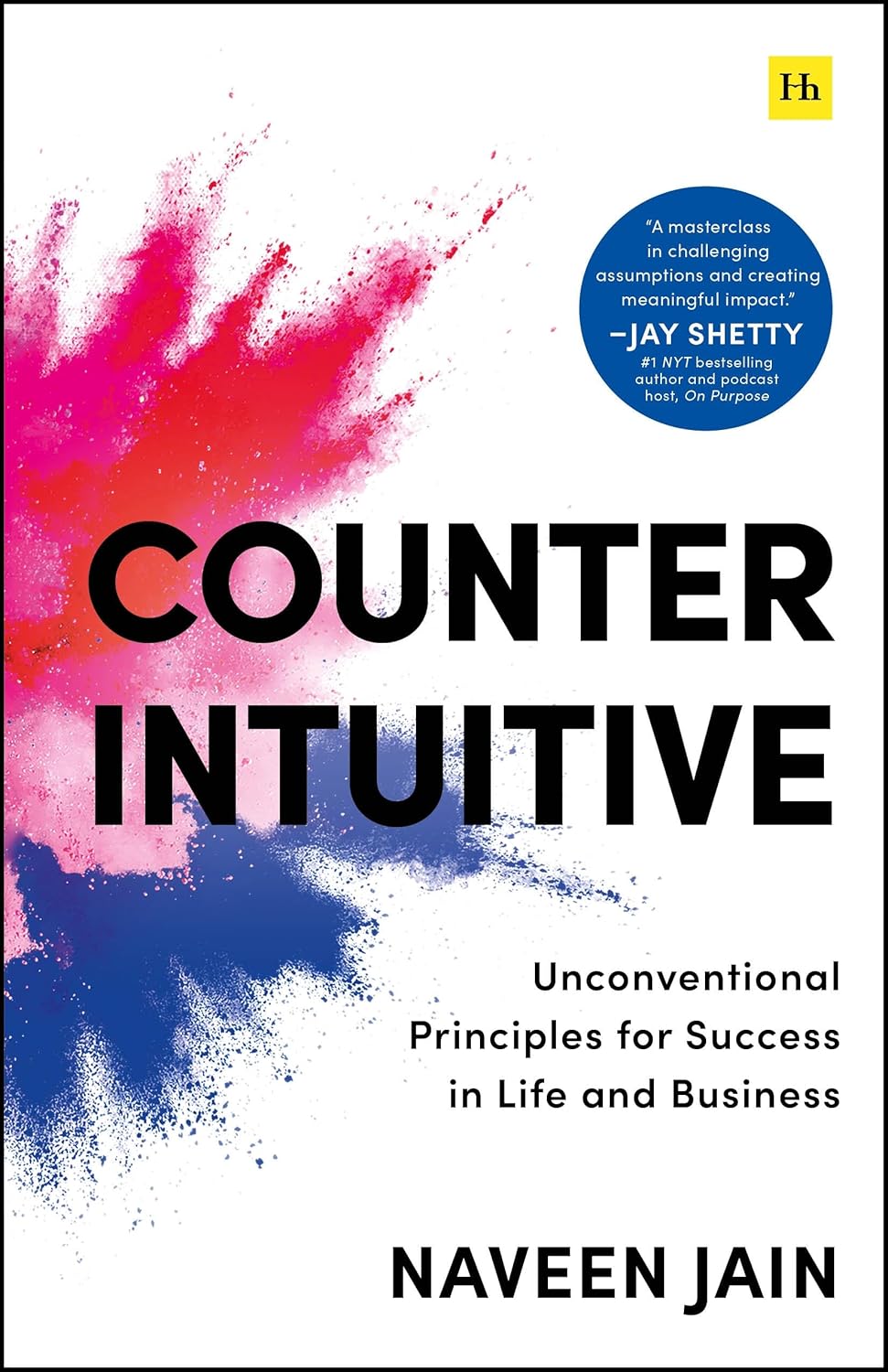
Some self-help books promise better habits. Others offer formulas for success. Counterintuitive by entrepreneur and innovator Naveen Jain attempts something far more ambitious—it asks readers to fundamentally rethink the way they see problems, opportunities and their own potential.
At its heart, Counterintuitive is not a manual on productivity or business strategy. It is a manifesto for independent thinking. Jain argues that the greatest barriers to success are rarely external; they are the invisible assumptions, inherited beliefs and accepted “rules” that quietly dictate how people approach life. His central proposition is deceptively simple: extraordinary outcomes begin by asking questions that most people never think to ask.
Drawing from his own entrepreneurial journey, Jain reflects on the mindset that enabled him to build multiple billion-dollar companies and pursue ventures many considered unrealistic. Rather than attributing success to exceptional intelligence, wealth or privilege, he credits an unwavering willingness to challenge convention, embrace uncertainty and imagine possibilities beyond accepted limits. Throughout the book, these personal experiences are woven into broader reflections on innovation, leadership and human potential, giving the narrative both credibility and momentum.
One of the book’s most compelling ideas is that thinking bigger is often easier than thinking small. Jain argues that incremental improvements rarely solve transformative problems. Instead, he encourages readers to shift their perspective entirely—to stop working within existing systems and begin questioning whether those systems should exist in their current form at all. It is an argument that feels particularly relevant in a world increasingly defined by rapid technological change and complex global challenges.
Unlike many titles in the self-help genre, Counterintuitive avoids becoming a checklist of motivational slogans or quick-fix strategies. Instead, it invites readers into an intellectual exercise, challenging them to examine how deeply social expectations, fear of failure and conventional wisdom shape their ambitions. Jain repeatedly reminds readers that imagination is not merely a creative talent but a discipline that can be cultivated through curiosity, bold questioning and a willingness to reject limiting assumptions.
The book’s literary strength lies in its ability to balance inspiration with reflection. Jain writes with the conviction of an entrepreneur but also with the curiosity of someone fascinated by how ideas evolve. His storytelling moves seamlessly between personal anecdotes, philosophical observations and practical insights, creating a narrative that is engaging without becoming overly prescriptive. Rather than dictating a single path to success, he encourages readers to develop a mindset capable of discovering their own.
Perhaps the book’s greatest achievement is its optimism. In an age where caution often dominates decision-making, Counterintuitive champions boldness—not as reckless ambition, but as a deliberate choice to see opportunity where others see impossibility. Jain argues that the future belongs to those willing to challenge accepted truths, embrace unconventional thinking and pursue solutions that initially appear unattainable.
For readers of contemporary self-help, Counterintuitive offers more than motivation. It offers a philosophy of possibility. Its message is not simply to dream bigger, but to think differently—to question the assumptions that quietly define success and recognise that meaningful breakthroughs often begin where conventional thinking ends.
Insightful, thought-provoking and refreshingly unconventional, Counterintuitive is a compelling read for entrepreneurs, innovators and anyone seeking to replace limiting beliefs with expansive thinking. It is less a guide to achieving success than an invitation to redefine what success can look like when imagination becomes one’s greatest asset.
