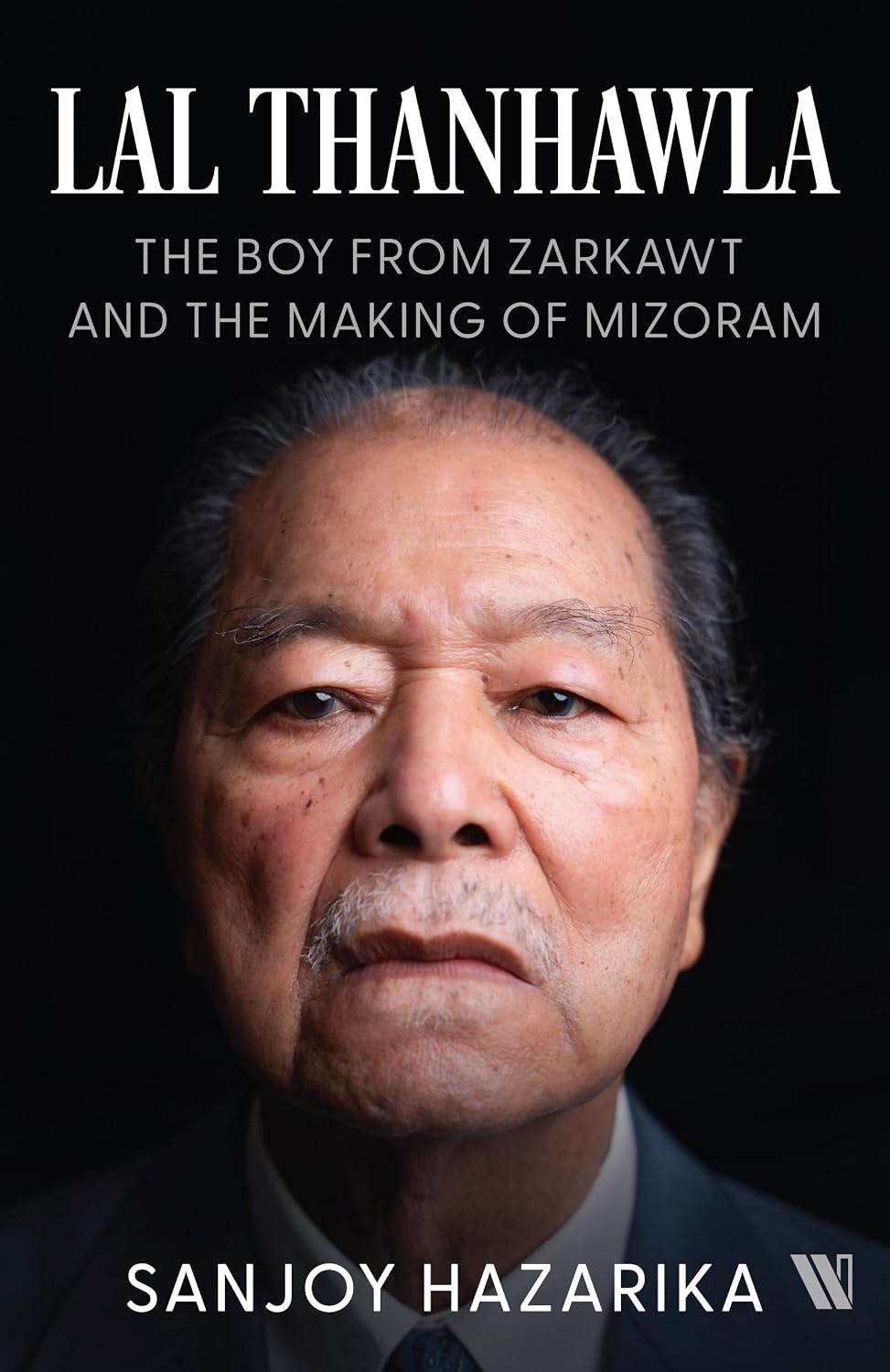
The history of Mizoram is also the story of a dramatic political transformation — from rebellion and armed insurgency to one of the most enduring peace settlements in India’s Northeast. In Lal Thanhawla: The Boy from Zarkawt and the Making of Mizoram, journalist and author Sanjoy Hazarika tells this larger story through the life of one of the state’s most influential political figures.
Lal Thanhawla, Mizoram’s longest-serving chief minister, lived through almost every major political turn that shaped the state. His journey from involvement in an anti-India movement to becoming a mainstream political leader and eventually helping create the conditions for peace gives Hazarika a striking lens through which to examine Mizoram’s evolution.
The book is therefore much more than a conventional political biography.
It traces Mizoram from the years of British rule through famine, political unrest, insurgency, negotiations and eventual stability, while placing Lal Thanhawla within those changing circumstances. His personal story becomes inseparable from the history of the state itself.
That is what makes the book particularly interesting.
Political biographies often focus heavily on elections, offices held and battles for power. Hazarika’s account appears to ask a broader question: what makes a political leader abandon a movement he once supported and choose accommodation, negotiation and democratic politics instead?
Lal Thanhawla’s political transformation is central to that question.
He had once been associated with an anti-India movement, but later emerged as a leader within the constitutional system. More significantly, he was part of a political generation that helped Mizoram move away from decades of violence and instability towards peace.
For Hazarika, this shift is not merely an interesting detail in Lal Thanhawla’s career. It represents one of the defining contradictions — and achievements — of his political life.
As the author himself puts it, Lal Thanhawla “had been part of an anti-India movement, rose to power and turned his back on it… to end an insurgency”.
That transformation allows the book to explore some of the hardest questions surrounding conflict politics: when does rebellion lose its purpose? What makes leaders change course? How is trust rebuilt between a population and the state after years of hostility? And what political compromises are necessary for peace to endure?
Hazarika is particularly well placed to tell this story.
A veteran journalist and researcher with decades of experience covering India’s Northeast, he has spent much of his career documenting the region’s politics, conflicts and social transformations. For this book, he draws on hundreds of interviews conducted over two years, along with archival material.
The scale of that research gives the biography the potential to function as both a portrait of an individual and a political history of Mizoram.
The subtitle, The Boy from Zarkawt and the Making of Mizoram, captures this dual ambition well. Lal Thanhawla’s rise from his early years in Zarkawt to the chief minister’s office is presented alongside the emergence of Mizoram from a remote frontier region into a state with its own distinct political identity.
The relationship between the Northeast and the Indian Union has often been told from New Delhi’s perspective — through insurgencies, security operations, peace agreements and questions of territorial integrity. Hazarika’s approach promises something different: viewing these developments through people who lived inside the political upheaval.
This matters because Mizoram’s transition to peace remains one of the most significant but comparatively less discussed political stories of modern India.
The state went through a long period of insurgency before the 1986 Mizoram Peace Accord brought the conflict to an end. What followed was equally important: former rebels entered democratic politics, institutions stabilised and violence gradually gave way to electoral competition.
Peace agreements are often judged by the moment they are signed. Mizoram’s experience suggests that their real success lies in what comes afterwards — whether former adversaries accept democratic institutions and whether political leadership can keep the settlement alive over decades.
Lal Thanhawla’s career sits at the centre of this transition.
His longevity in politics also provides a window into the changing aspirations of Mizoram. Through his life, the book can be read not merely as an account of one politician’s rise and survival but as a study of how leadership changes when a society moves from conflict to governance.
Hazarika also attempts to bring Mizoram’s history to readers beyond the Northeast. This is an important intervention in itself.
Despite the region’s strategic and political significance, the histories of India’s northeastern states remain underrepresented in mainstream national narratives. Political developments there are frequently noticed only when there is violence, an election or a crisis.
A biography such as this challenges that episodic understanding.
It draws attention to the personalities, social forces and political negotiations that shaped Mizoram over decades, while also showing that the history of the Northeast cannot be reduced to insurgency alone.
There is another layer to Lal Thanhawla’s story that makes it especially relevant today: the ability of political opponents and insurgent movements to eventually find space within democratic institutions.
At a time when conflicts in different parts of the world often appear permanent, Mizoram offers evidence that seemingly irreconcilable political positions can change. But the book also appears to suggest that peace does not emerge simply from one agreement. It depends on individuals willing to reconsider old positions, institutions capable of accommodating former opponents and a society prepared to move beyond violence.
Seen from this perspective, Lal Thanhawla’s life represents something larger than political success.
His story is about transition — from insurgency to electoral politics, confrontation to negotiation and political alienation to participation.
Hazarika does not appear interested merely in celebrating that transformation. By locating Lal Thanhawla within the complicated history that produced him, the book seeks to understand how political choices are shaped by circumstances and how individuals, in turn, can influence the course of history.
Lal Thanhawla: The Boy from Zarkawt and the Making of Mizoram is therefore not just the biography of Mizoram’s longest-serving chief minister. It is an account of a state finding its way through rebellion, violence and uncertainty towards a durable peace.
And perhaps that is the book’s most important contribution: reminding readers that behind every peace accord lie years of conflict, difficult compromises and people willing, at crucial moments, to change course.
Book: Lal Thanhawla: The Boy from Zarkawt and the Making of Mizoram
Author: Sanjoy Hazarika
Publisher: Westland Books
