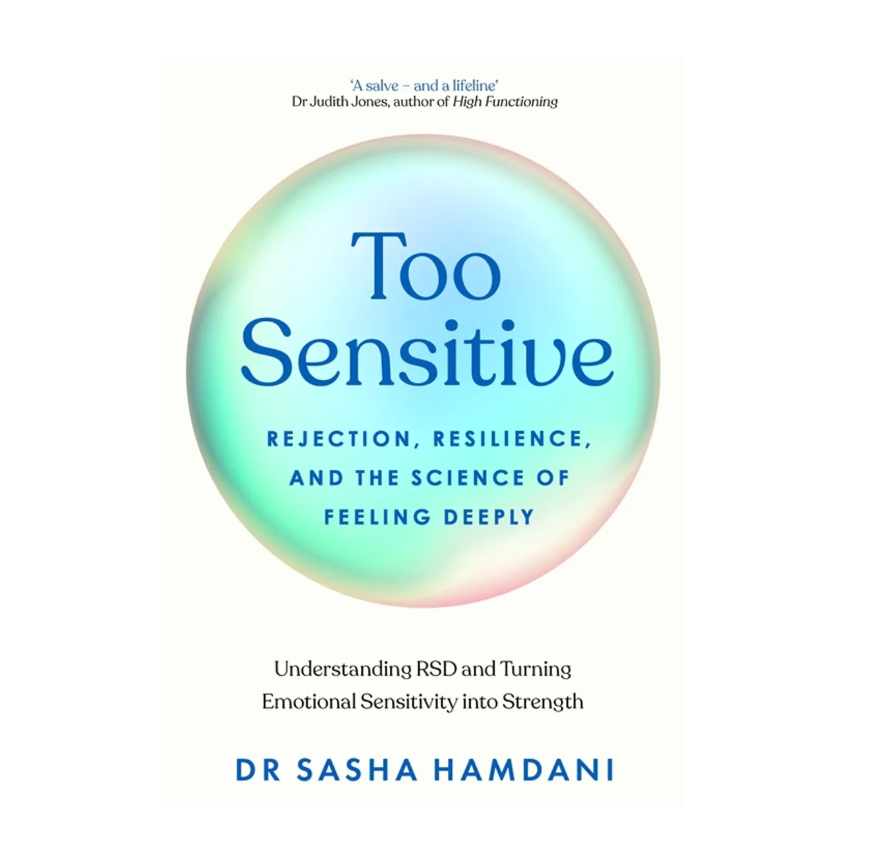
A delayed reply from a friend, a curt message from a manager or a moment of distance from a partner can sometimes trigger a reaction far bigger than the situation appears to warrant. In Too Sensitive, psychiatrist Dr Sasha Hamdani examines why such moments can feel so intense and how people can learn to respond to them differently.
The book focuses on Rejection Sensitive Dysphoria, or RSD, a term used to describe extreme emotional pain linked to perceived rejection, criticism or failure. It is often discussed in connection with ADHD, although Hamdani makes clear that such sensitivity is not limited to people with ADHD.
What makes Too Sensitive accessible is the way it begins with familiar, everyday situations rather than medical terminology. The reader is invited to recognise patterns: replaying conversations, assuming the worst after a short message, or interpreting temporary distance as evidence that a relationship is falling apart.
Hamdani combines psychiatry and neuroscience with her own experience of emotional sensitivity. Rather than treating intense emotional reactions as something to be dismissed, she tries to explain what may be happening beneath them.
A major part of the book is practical. Hamdani introduces a 12-step “Calm Your Mind” approach, which includes identifying emotions, recognising triggers and developing ways to interrupt spiralling thoughts before they become overwhelming. The book also includes a questionnaire designed to help readers reflect on their own level of emotional sensitivity.

Its usefulness extends beyond self-understanding. Separate sections look at situations that can trigger rejection sensitivity in friendships, romantic relationships, family life, the workplace and questions of self-worth. This gives the book a strong real-world focus.
The tone is reassuring without being overly clinical. Hamdani appears less interested in telling readers to simply become “less sensitive” and more interested in helping them understand why they react as they do and what they can do with that knowledge.
That is also the central strength of Too Sensitive. It challenges the assumption that emotional sensitivity is automatically a weakness. Instead, the book asks whether understanding those emotions more clearly can help people manage them without losing the empathy, awareness and intensity that may also be part of their personality.
At 320 pages, Too Sensitive combines explanation, self-reflection and practical exercises in a format aimed at the general reader. For people who regularly find themselves overthinking criticism, fearing rejection or spiralling after seemingly small interactions, the book offers both a vocabulary for those experiences and a set of tools for dealing with them.
Ultimately, Hamdani’s message is simple: sensitivity does not have to control your relationships, work or sense of self. Understanding it may be the first step towards turning an exhausting emotional pattern into something more manageable—and perhaps even into a strength.
