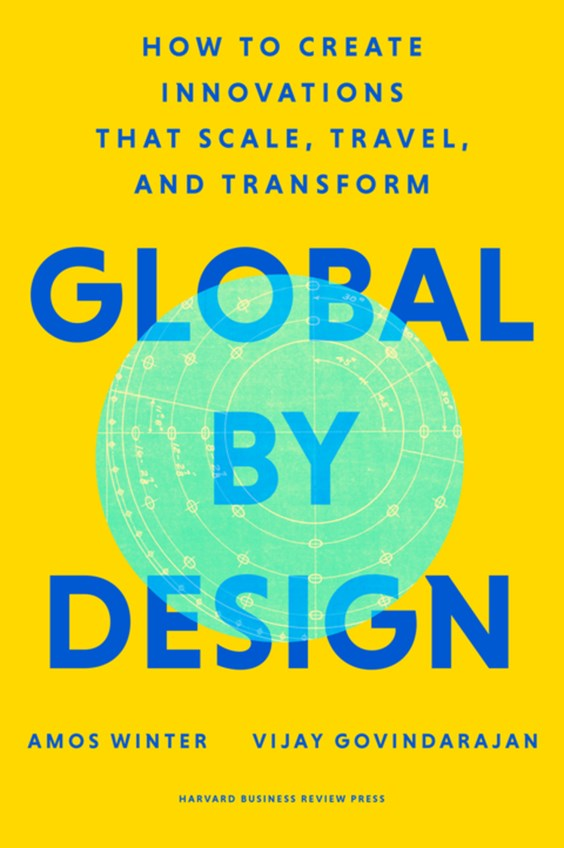
What if some of the world’s most transformative innovations are created not in Silicon Valley, but in emerging markets such as India? A new book by MIT engineering professor Amos Winter and strategy and innovation expert Vijay Govindarajan explores how resource constraints, affordability and overlooked consumer needs can become catalysts for products with global potential.
Global by Design: How to Create Innovations That Scale, Travel, and Transform, published by Penguin Random House India under its HBR imprint, brings together design thinking and the concept of “reverse innovation” to challenge the traditional approach of developing products first for wealthy markets and subsequently adapting them for emerging economies.
The authors argue that innovation can work in the opposite direction. By starting with customers who are often overlooked because of limited purchasing power or access to resources, companies can develop solutions that deliver high value at lower cost. Such products, they suggest, can subsequently find applications across income groups, industries and developed markets.
The book draws on case studies to examine how engineers, designers, entrepreneurs and business leaders can identify problems that have traditionally received little attention and turn constraints into opportunities for innovation. It presents a framework for designing products around real-world needs while keeping their potential for wider adoption in mind.
The idea has particular relevance for India, which is increasingly emerging not only as a large consumer market but also as a testing ground and source of innovations designed around affordability, scale and access.
“Global by Design” also examines a broader question facing businesses: who gets designed for, and where does innovation actually come from? According to the authors, solutions created for emerging markets need not remain confined to those markets and can potentially challenge established products in wealthier economies.
Amos Winter is Germeshausen Professor of Mechanical Engineering and director of the K. Lisa Yang Global Engineering and Research (GEAR) Center at the Massachusetts Institute of Technology. His work has focused on technical challenges in developing countries, including drip irrigation, water purification, agricultural equipment and assistive technology.
Vijay Govindarajan is Coxe Distinguished Professor of Management at Dartmouth’s Tuck School of Business and a leading scholar of strategy and innovation. He is also the author of Reverse Innovation and The Three-Box Solution.
The book is aimed at CEOs, product leaders, engineers, designers, entrepreneurs, marketers and policymakers looking to understand how innovations born out of constraints can move beyond their original markets and influence the way products are designed globally.
