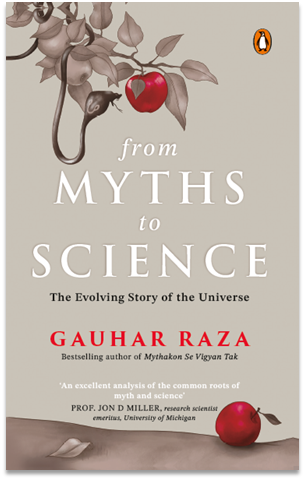
Penguin Random House releases a powerful new book that questions why superstition still thrives in a scientifically advanced India.
As India continues to make global headlines for its scientific achievements—from space missions to digital innovation—a new book by renowned scientist, poet, and filmmaker Gauhar Raza asks a provocative question: Why do superstition and irrational beliefs still flourish in a country that has embraced cutting-edge science and technology?
Titled From Myths to Science, the book, published by Penguin Random House, explores the complex and often uneasy relationship between faith and reason in Indian society. Blending history, philosophy, science, and current affairs, Raza offers a compelling narrative on how irrational practices continue to shape public thinking, policies, and politics—despite growing access to scientific knowledge.
“India is a paradox,” writes Raza. “We have reached the Moon and Mars, yet miracle cures, astrology shows, and numerology still dominate the public imagination.”
A Nation of Contrasts
The book delves into this contradiction with clarity and urgency. On one hand, India has emerged as a global tech hub, with a thriving scientific community and a digital economy that is reshaping the future. On the other, blind faith and pseudo-science often play outsized roles in daily life, media, and even electoral strategies.
From television shows that peddle astrology to politicians who consult numerologists before making major decisions, From Myths to Science lays bare the ways in which superstition is normalized, often at the cost of rational discourse and scientific temper.
Dissecting Faith, Belief, and Politics
Raza makes an important distinction in the book: religion, faith, tradition, and belief are not interchangeable—and each connects with science in different ways. While religion can offer meaning and emotional comfort, he argues, it is often weaponized in politics to create division and manipulate public opinion.
The book also challenges the assumption that access to information automatically leads to rational thinking. “Even in the internet age, scientific misinformation spreads faster than facts,” Raza warns.
In examining how and why this happens, Raza introduces readers to the ‘Cultural Distance Model’—his influential theory on how people relate to scientific knowledge based on their social and cultural context. This model helps explain why many people continue to embrace irrational ideas despite having the tools to question them.
Bridging Science and Storytelling
Written in an accessible and engaging style, From Myths to Science is aimed at students, educators, policy makers, scientists, and anyone interested in the role of science in a democratic society. It is a call to action—to uphold the constitutional promise of building a rational, secular society rooted in scientific thinking.
The book has already earned high praise from scholars and public intellectuals.
“An excellent analysis of the common roots of myth and science,” says Prof. Jon D. Miller, research scientist emeritus at the University of Michigan.
“A masterful account of how science rose from myth and faith,” adds Mridula Mukherjee, former professor at Jawaharlal Nehru University.
“Raza tackles with grace, passion and clarity that great dilemma of science communication—translating concepts into narrative,” notes Martin W. Bauer, professor at the London School of Economics.
About the Author
Gauhar Raza is no stranger to the intersection of science and society. A former Chief Scientist at CSIR-NIScPR, he is widely recognized for his contributions to science communication in India. His acclaimed documentaries—In Dark Times, Inqilab, and Jung-e-Azadi—as well as his powerful Urdu poetry, have made him a respected public intellectual.
He is also the founding editor of The Journal of Scientific Temper, and has represented India at several international forums advocating for progressive and rationalist values.
From Myths to Science is more than just a critique of superstition—it is a timely reminder that India’s progress must not only be measured by satellites and startups, but also by how deeply scientific reasoning and critical thinking are embedded in its social fabric.
