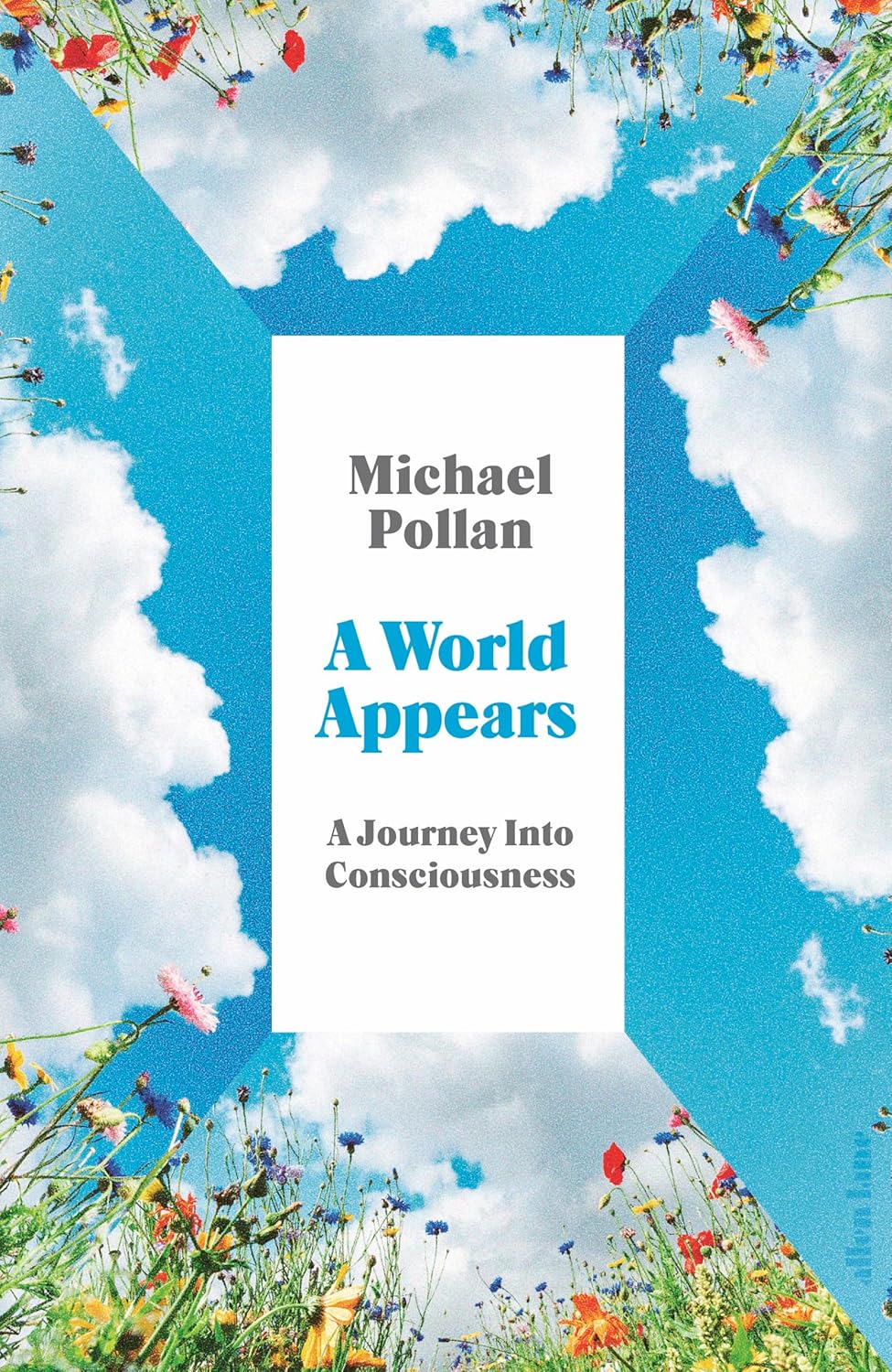
Writing about consciousness is a peculiar undertaking. It is the one subject we all know intimately and yet cannot fully explain. In A World Appears, Michael Pollan takes on this paradox with a mix of curiosity and restraint, resisting the temptation to offer neat conclusions where none seem possible.
The book begins in familiar territory—the scientific quest to locate consciousness within the brain. For decades, researchers have tried to map subjective experience onto neural activity, working on the assumption that what we feel and perceive can eventually be explained in biological terms. Pollan follows this trail but does not remain confined to it for long. The deeper he goes, the more the certainty of that project begins to loosen. The question is no longer just how consciousness arises, but whether it can be fully captured by the methods we have come to trust.
What gives the book its texture is Pollan’s willingness to move beyond the laboratory. He seeks out philosophers, writers, and Buddhist practitioners, opening the discussion to ways of thinking that science alone has often kept at arm’s length. The result is not a clash of disciplines, but a widening of perspective. Consciousness, Pollan suggests, may require a language that draws as much from lived experience and introspection as from measurement and data.
Organised around themes such as sentience, feeling, thought, and selfhood, the book attempts to navigate a subject that resists tidy boundaries. Pollan explores ideas that range from the provocative to the speculative—the possibility that plants might possess a form of awareness, for instance, or the limits of human perception when confronted with other kinds of intelligence. These passages are less about proving a point than about unsettling assumptions, particularly the human tendency to treat its own mode of awareness as the standard against which all else is measured.
The discussion of artificial intelligence introduces a more contemporary anxiety. Can machines ever be conscious? Pollan remains doubtful. He points to the deeply embodied nature of human experience—the role of sensation, vulnerability, and physical existence in shaping what we call consciousness. It is a reminder that awareness is not simply a matter of processing information, but of inhabiting a body that feels, reacts, and endures.
As the book moves into questions of thought and identity, it becomes more reflective in tone. Pollan turns to literature to illustrate the restless, often fragmented nature of the mind, and to memory as the thread that gives continuity to the self. These sections are less technical, but they carry a quiet insight: that the self we take for granted is neither fixed nor entirely coherent.
Perhaps the most striking aspect of A World Appears is its refusal to settle the matter. Pollan does not claim to have found answers; if anything, his journey leaves him with more questions than he began with. This openness can make the book demanding. It does not guide the reader toward a clear resolution, nor does it simplify the complexities it encounters. But that, ultimately, is its strength. It mirrors the very nature of its subject—elusive, layered, and resistant to closure.
The closing chapters, set in a Buddhist retreat in the mountains of New Mexico, shift the focus from explanation to experience. Here, Pollan confronts the idea that understanding consciousness may be less important than engaging with it directly. The attempt to quiet the self, even temporarily, offers no grand revelation, but it reframes the inquiry in a more immediate, personal way.
This is not a book for those seeking quick clarity. It demands patience and a willingness to sit with ambiguity. At times, it can feel dense, even disorienting. Yet for readers drawn to questions that do not yield easy answers, Pollan offers something valuable—a thoughtful, wide-ranging exploration that treats consciousness not as a problem to be solved, but as a mystery to be approached with humility.
In the end, A World Appears leaves you not with certainty, but with a sharpened sense of wonder. And perhaps that is as close as one can come to understanding a phenomenon that defines our very experience of being alive.
