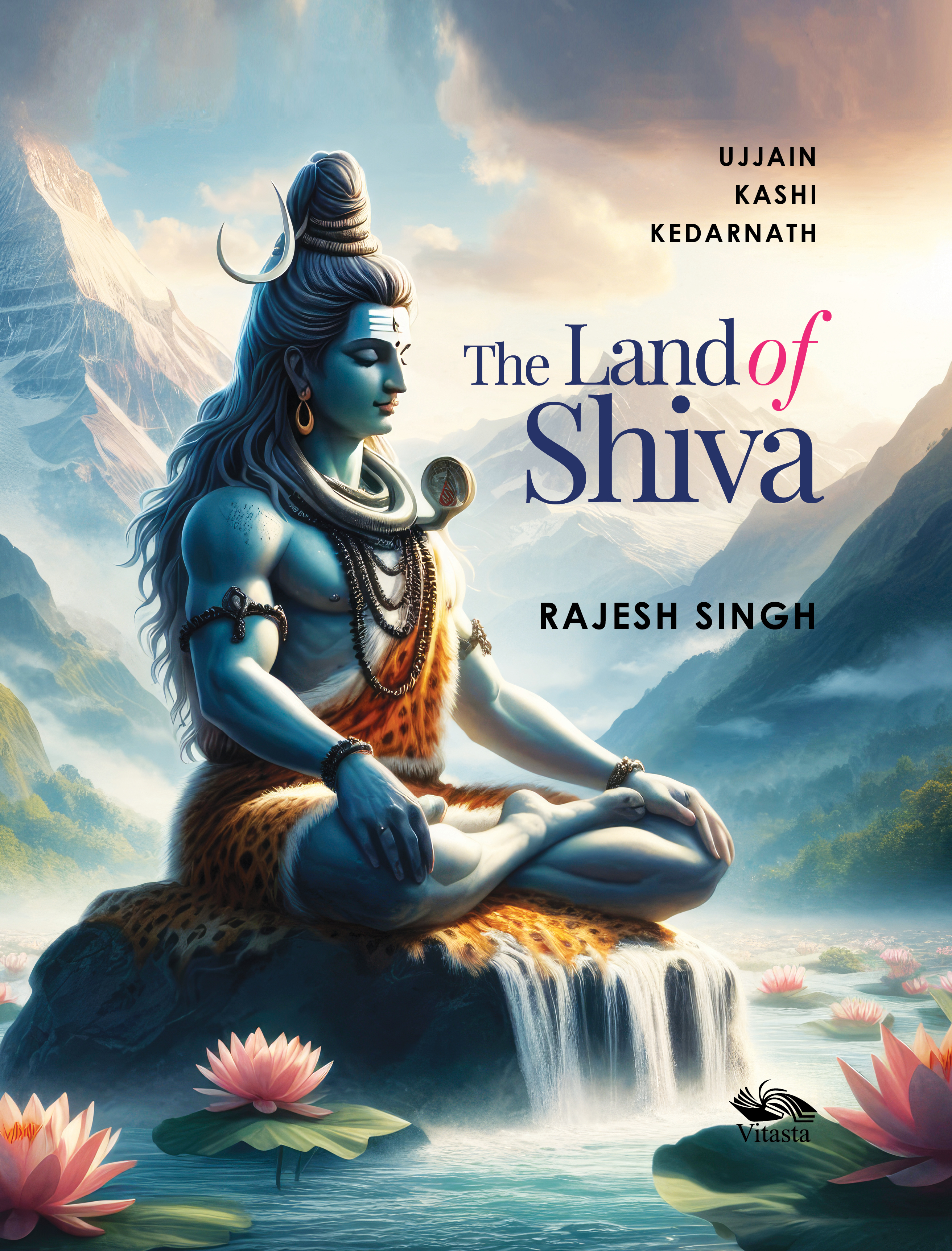
Some books are meant to be flipped through. The Land of Shiva asks to be read, paused over, and thought about. Rajesh Singh’s work may arrive in the familiar format of a coffee-table book—lush visuals, sweeping frames of temples and landscapes—but it carries a deeper intent. It is as much about the present as it is about the past, as much about identity as it is about devotion. At its heart lies a simple but powerful idea: that Kashi, Ujjain, and Kedarnath are not just places on a map, but living centres of a civilisation rediscovering itself.
More Than a Coffee-Table Book
The Land of Shiva by Rajesh Singh is a visually rich and thoughtfully argued exploration of three of India’s most sacred Shaivite centres—Kashi, Ujjain, and Kedarnath—tracing their enduring spiritual significance alongside their contemporary transformation. Blending history, mythology, and on-ground observation, the book situates these ancient sites within a larger narrative of cultural renewal, where faith, architecture, and national identity intersect in a rapidly changing India.
Kashi: Where Time Stands Still
Varanasi does not ease you in. It overwhelms, confuses, and then, slowly, reveals itself.
In Singh’s telling, Kashi is not just the city of Shiva—it is where the idea of eternity becomes tangible. The ghats along the Ganga carry a rhythm that feels both chaotic and deeply ordered. Life unfolds alongside death without discomfort or denial. A funeral procession passes as a group of pilgrims take a dip; chants rise even as conversations drift through narrow lanes.
Singh resists the temptation to over-explain Kashi. Instead, he lets it remain what it has always been—a place that must be experienced before it can be understood. Shiva here is Vishwanath, the lord of all, the quiet presence that turns the city into a threshold between the temporal and the eternal.

Ujjain: In the Shadow of Mahakal
If Kashi is about timelessness, Ujjain is about time itself.
The city of Mahakaleshwar carries a different energy—less overwhelming, more inward. Here, Shiva is Mahakal, the one who governs time, who stands beyond its limits. Singh draws attention to Ujjain’s layered past—as a centre of astronomy, learning, and trade—where spiritual inquiry once walked hand in hand with scientific thought.
There is a certain stillness in Ujjain that the book captures well. The rituals, the temple corridors, the steady flow of devotees—it all feels measured, almost deliberate. It is a city that doesn’t demand attention but rewards those who stay long enough to notice its rhythm.
Kedarnath: Faith Against the Elements
Then the landscape shifts, dramatically.
Kedarnath is not a city—it is an experience. Set against the stark, unforgiving backdrop of the Himalayas, it strips devotion down to its essentials. The journey itself becomes part of the prayer.
Singh’s writing is at its most evocative here. The memory of the 2013 floods lingers, not as spectacle but as context. What stands out is not just the scale of the disaster, but the persistence that followed—the rebuilding, the return of pilgrims, the refusal to let faith recede.
In Kedarnath, Shiva is elemental—present in the mountains, in the silence, in the sheer effort it takes to reach the temple. It is a place that doesn’t offer comfort so much as clarity.
Restoration and the Politics of Faith
Threaded through the book is a clear engagement with the present—particularly the transformation of these sites in recent years.
Singh places significant emphasis on the role of Prime Minister Narendra Modi, framing the developments in Kashi, Ujjain, and Kedarnath as part of a broader cultural resurgence. The Kashi Vishwanath Corridor is described as an opening up of space—physically and symbolically—reconnecting the temple with the Ganga. The Mahakal Lok project in Ujjain is presented as a restoration of lost grandeur. Kedarnath’s reconstruction, following the floods, becomes a story of resilience backed by state support.
There is also an underlying suggestion that Modi’s connection to these places is not merely administrative. As the Member of Parliament from Varanasi and a frequent presence in Kedarnath, he is portrayed as a political figure with a visible spiritual affinity for these sites. Singh leans into this idea, seeing in it a blend of governance and cultural conviction.
Not every reader may agree with this framing, but it is central to the book’s narrative—and it is presented with clarity rather than hesitation.
A Visual Narrative with Conviction
The book’s visual strength is undeniable. The photographs do more than decorate—they deepen the experience. From the play of light on the Ganga to the vast stillness of the Himalayas, each image reinforces the emotional texture of the text.
What sets The Land of Shiva apart, however, is that it does not hide behind its visuals. It has a point of view, and it owns it. Singh writes with the confidence of someone who has reported, observed, and formed an opinion. The result is a narrative that feels both informed and personal.
Why These Places Still Matter
Long after the last page, what stays with you is not just the imagery or even the argument—it is the question the book leaves behind.
Why do Kashi, Ujjain, and Kedarnath continue to matter so deeply?
Perhaps because they offer something that modern life often lacks—a sense of continuity. In these spaces, the past is not distant; it is lived, repeated, and renewed every day. Faith is not an abstract idea; it is woven into routine, into geography, into memory.
The Land of Shiva does not try to resolve this complexity. It simply brings it into focus—patiently, vividly, and with a certain conviction that these places, and what they represent, are central to understanding India today.
