There was a time when artificial intelligence belonged mostly to science fiction, academic laboratories, and Silicon Valley promises. Today it writes emails, generates images, reshapes classrooms, powers surveillance systems, unsettles entire industries, and increasingly influences how human beings think, work, and interact. AI is no longer approaching everyday life; it has already entered it.
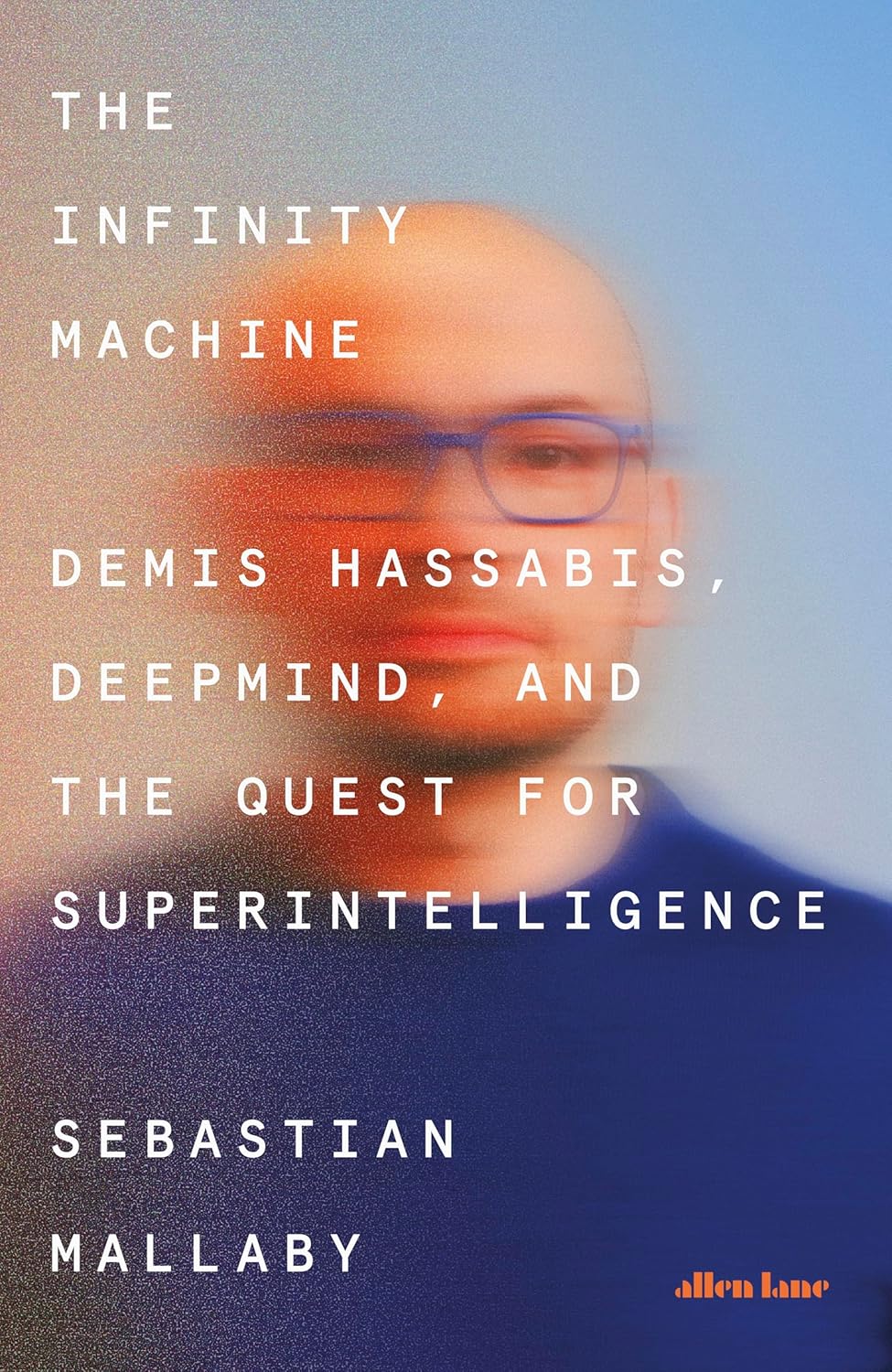
That is what makes The Infinity Machine by Sebastian Mallaby feel so timely. More than a biography of DeepMind cofounder Demis Hassabis, the book attempts something larger: to explain the psychology, ambition, and worldview behind the people racing to build artificial general intelligence—machines capable of rivaling or surpassing human intelligence itself.
Mallaby, one of the sharpest chroniclers of power and finance writing today, brings the same deeply reported narrative style that defined More Money Than God. With extensive access to Hassabis, his colleagues, competitors, critics, and investors—including figures such as Mustafa Suleyman, Ilya Sutskever, and Geoffrey Hinton—he constructs a sweeping story about ambition, genius, ideology, and technological acceleration.
At the center stands Demis Hassabis: chess prodigy, neuroscientist, game designer, entrepreneur, Nobel Prize-winning scientist, and now one of the most influential figures shaping the AI era.
And yet, despite the scale of its subject, The Infinity Machine is at its best not when discussing technology, but when observing the intensely human contradictions behind it.
Mallaby traces Hassabis’s remarkable rise from a child chess phenomenon in North London to the head of DeepMind, the company whose AlphaGo victory over legendary Go player Lee Se-dol in 2016 became one of the defining symbolic moments in AI history. The match was watched globally not merely as a game, but as a civilizational milestone. Chess had already fallen to machines decades earlier, but Go—with its near-infinite strategic possibilities—still seemed uniquely human. When AlphaGo defeated Lee Se-dol four games to one, it felt as though the future had arrived ahead of schedule.
Mallaby captures this atmosphere effectively. He understands how moments like these transformed AI from a niche scientific field into a cultural obsession. What emerges throughout the book is a portrait of a generation of technologists who increasingly see themselves not simply as engineers, but as architects of humanity’s next evolutionary leap.
That tension gives the book its energy.
Hassabis himself is a fascinating figure precisely because he does not fit neatly into the familiar tech-founder stereotype. Unlike the performative chaos associated with Elon Musk or the aggressive evangelism of Silicon Valley futurists, Hassabis often comes across as cerebral, cautious, and academically driven. His background in neuroscience and gaming gives him a broader intellectual curiosity than many of his peers. His work on protein folding through DeepMind’s AlphaFold project—which earned him the Nobel Prize in Chemistry alongside John Jumper—may ultimately prove more transformative than many of AI’s headline-grabbing chatbot products.
These sections are among the strongest in the book. Here, AI feels less like corporate spectacle and more like a genuine scientific breakthrough capable of reshaping medicine and biological research.
But The Infinity Machine is also a story about power, and this is where the narrative becomes more complicated.
Mallaby presents the AI race as one of the defining geopolitical and ethical struggles of the century. Governments, corporations, venture capitalists, and billionaires are all competing to control technologies whose consequences remain uncertain even to their creators. DeepMind’s rivalry with OpenAI, especially around the release of ChatGPT, forms an important thread running through the book. OpenAI’s Sam Altman emerges as both visionary and disruptor—someone willing to commercialize rapidly while others hesitated.
Yet the book occasionally slips into the same mythology it tries to examine.
Mallaby is clearly captivated by the world he is describing, and at times that fascination blunts his skepticism. Silicon Valley’s grand declarations about “changing humanity,” “solving intelligence,” or “finding God’s algorithm” are often presented with limited interrogation. The AI industry’s tendency toward quasi-religious language—where technological advancement becomes inseparable from salvation narratives—deserved a more critical distance than the book consistently provides.
This becomes especially noticeable in conversations around AGI. Many figures in the book speak with near-messianic certainty about creating systems that could transform civilization itself. But beyond the rhetoric lies a harder question: who benefits, who controls these systems, and what happens when commercial incentives outrun ethical safeguards?

The book raises these concerns, though not always deeply enough.
Still, even where one disagrees with Mallaby’s framing, the reporting remains immensely compelling. He excels at showing how elite technology ecosystems function: the investor dinners, philosophical debates, internal rivalries, recruitment wars, and ideological clashes that shape the future behind closed doors. The world of AI here feels both intoxicating and unsettling—a place where extraordinary intelligence coexists with extraordinary hubris.
Importantly, The Infinity Machine arrives at a moment when public perception of AI is rapidly shifting. The early excitement surrounding generative AI is increasingly accompanied by anxiety about job displacement, misinformation, surveillance, copyright battles, and the concentration of technological power inside a handful of corporations. Against this backdrop, Mallaby’s book succeeds in humanizing the people behind the machines without entirely absolving them.
That balance matters.
Because ultimately, the most important insight running through The Infinity Machine is that AI’s future will not be determined by algorithms alone. It will be shaped by the ambitions, fears, egos, ethics, and limitations of the humans building it.
The book may occasionally lean too close to admiration, but it remains an engrossing, significant, and highly readable account of one of the defining technological transformations of our age. Part biography, part corporate thriller, part intellectual history, The Infinity Machine offers readers a rare inside look at the personalities and philosophies driving the AI revolution.
And whether one views that revolution with excitement or apprehension, one thing now seems undeniable: the story of artificial intelligence is no longer about machines alone. It is about the people deciding what humanity becomes next.
