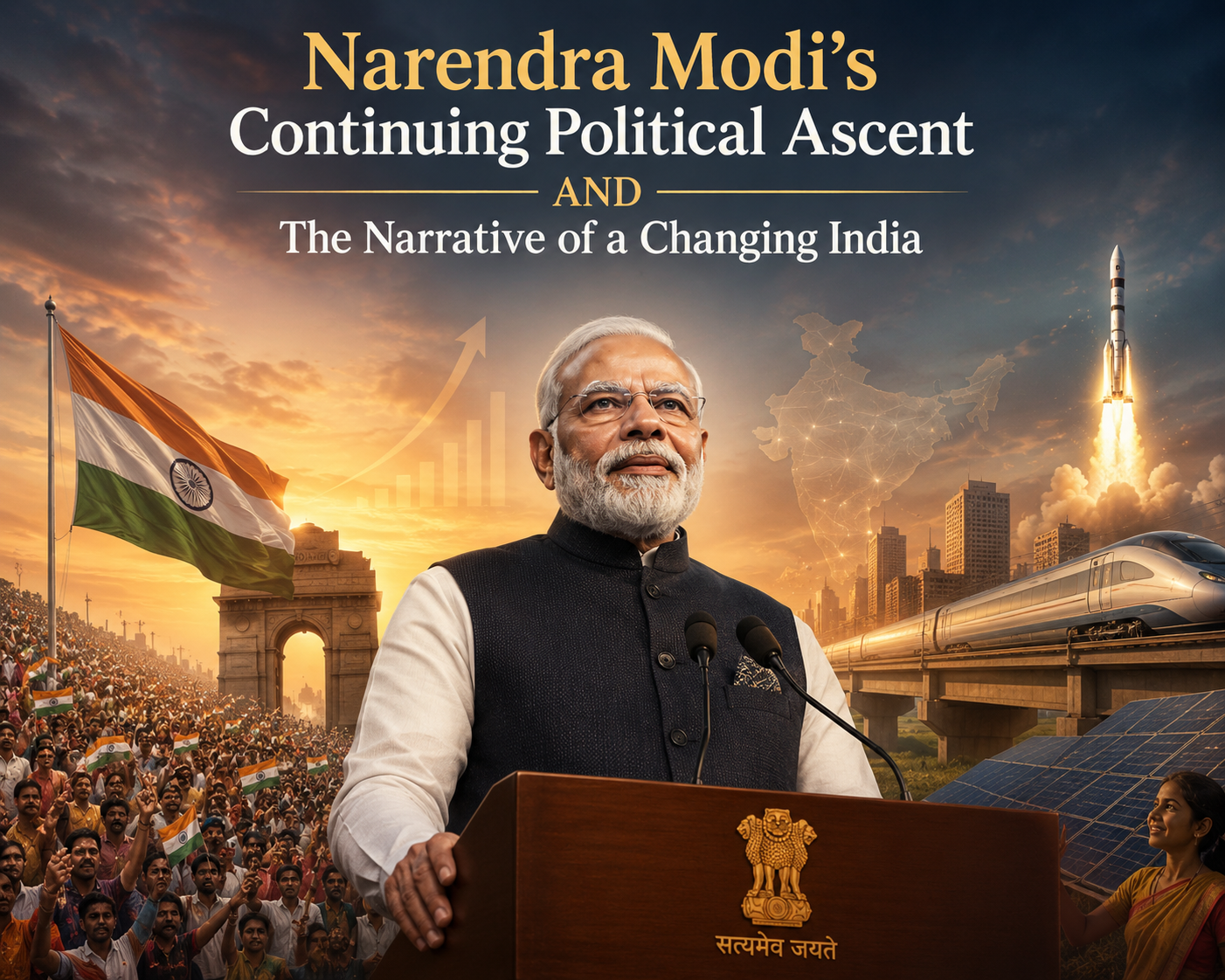
Narendra Modi’s return to power in 2024 for a third consecutive term has reinforced his position as one of the most consequential political leaders in contemporary India. Over the last decade and more, Modi has transformed himself from a regional administrator associated with Gujarat’s development model into a global political figure whose leadership style, governance philosophy, and nationalist messaging have reshaped the country’s political discourse. His supporters view him not merely as an elected leader but as the architect of a new India—one that seeks economic strength, technological advancement, cultural confidence, and a larger role in global affairs. From infrastructure expansion and digital governance to welfare delivery and diplomatic outreach, Modi’s tenure has been marked by ambitious initiatives designed to project India as a rising global power.
The political significance of Modi’s success lies not only in electoral victories but also in the durability of his appeal across social and geographic boundaries. Even amid criticism over economic inequality, unemployment concerns, and political polarization, Modi has retained a strong connection with a large section of voters through a carefully cultivated image of discipline, decisiveness, and nationalism. Government schemes such as Digital India, UPI expansion, rural electrification, direct benefit transfers, housing initiatives, and infrastructure projects have helped build the perception of a government focused on delivery and scale. Simultaneously, India’s growing global visibility—through G20 leadership, strategic diplomacy, and manufacturing ambitions—has strengthened the narrative of India emerging as a confident and assertive nation under Modi’s stewardship.
The books discussed below collectively attempt to understand this phenomenon from different perspectives. Some interpret Modi’s rise as a transformational political movement, others focus on leadership philosophy, governance outcomes, or India’s civilizational aspirations. Together, they reflect the expanding body of literature that seeks to explain how Narendra Modi has become central to contemporary discussions about India’s identity, development trajectory, and future ambitions.
Transforming India: Gamechanger in Action — Sudesh Verma

In Transforming India: Gamechanger in Action, Sudesh Verma revisits the themes he first explored in his earlier bestselling work Narendra Modi: The GameChanger. This book presents Modi’s political journey not simply as a personal success story but as a wider national transformation. Verma argues that India’s rise from being categorized among the “fragile five” economies to becoming one of the world’s fastest-growing and most influential nations is closely linked to Modi’s governance model and strategic leadership. The book positions Modi as a leader who challenged political conventions through bold decision-making and a relentless focus on execution.
The narrative examines key policy initiatives, welfare schemes, economic reforms, and diplomatic achievements undertaken during Modi’s tenure. Rather than focusing solely on biography, Verma evaluates the impact of Modi’s governance across social, economic, and political dimensions. The book emphasizes themes such as national confidence, infrastructure expansion, technological modernization, and India’s emergence as a stronger global voice. Through its celebratory tone, the work seeks to portray Modi as a transformative force whose policies are reshaping India’s long-term trajectory.
Modi’s Mission — Berjis Desai

Berjis Desai’s Modi’s Mission approaches Narendra Modi through a more philosophical and civilizational lens. The book frames Modi not merely as a politician but as the embodiment of a larger national awakening rooted in India’s cultural and spiritual identity. Desai traces Modi’s journey from poverty in Vadnagar to the highest political office in the country, presenting it as a story driven by destiny, discipline, and ideological conviction. The narrative highlights the influence of the Rashtriya Swayamsevak Sangh (RSS), spirituality, and Gujarat’s developmental experience in shaping Modi’s worldview.
What distinguishes this work is its emphasis on the idea of “mission” rather than personality alone. Desai argues that Modi’s political project seeks to redefine India’s self-perception by combining governance efficiency with civilizational pride. The book discusses transparency, nationalism, and cultural resurgence as central themes of Modi’s leadership. Rich with anecdotes and political observations, Modi’s Mission portrays Modi as a leader attempting to transform India from a postcolonial state into a self-confident civilization-state with a renewed sense of purpose and identity.
Bharat Rising of Vishwa Guru — Dr. Vivek Singh

Dr. Vivek Singh’s Bharat Rising of Vishwa Guru examines Narendra Modi’s leadership through the framework of India’s global aspirations. The book focuses on Modi’s role in positioning India as a “Vishwa Guru,” or global guide, blending economic development with cultural confidence and strategic diplomacy. Singh provides a detailed account of Modi’s rise in Indian politics, emphasizing his resilience, communication skills, and unwavering nationalist outlook. The author portrays Modi as a leader driven by a deep emotional connection to the nation and a desire to elevate India’s standing in the world.
A notable feature of the book is its attempt to balance admiration with analysis. Singh studies Modi’s economic policies, governance initiatives, social reforms, and foreign policy engagements while encouraging readers to critically understand their broader significance. The narrative highlights programs aimed at modernization, self-reliance, and global engagement, while also discussing India’s changing image on the international stage. Written in an accessible yet analytical style, the book contributes to the growing discourse around Modi’s leadership as part of a larger story about India’s rise in the twenty-first century.
Power Within: The Leadership Legacy of Narendra Modi — R. Balasubramaniam

In Power Within, R. Balasubramaniam explores Narendra Modi’s leadership through both Western leadership theories and Indic philosophical traditions. Rather than focusing only on political milestones, the book studies the evolution of Modi’s leadership style over five decades of public life. Balasubramaniam argues that Indian traditions emphasize the “exercise of leadership” over merely possessing leadership traits, and he uses Modi’s journey to illustrate this distinction. The book examines how Modi’s formative experiences, organizational discipline, and commitment to public service shaped his leadership philosophy.
Drawing on anecdotes from colleagues and associates, the author presents Modi as a leader deeply committed to self-discipline, communication, and purposeful action. The narrative highlights his ability to connect with people, mobilize large-scale administrative efforts, and maintain a long-term strategic vision. At the same time, Power Within attempts to provide broader lessons on leadership for aspiring public servants and administrators. By blending political biography with philosophical reflection, the book positions Modi’s career as both a political case study and a model for understanding leadership in the Indian context.
