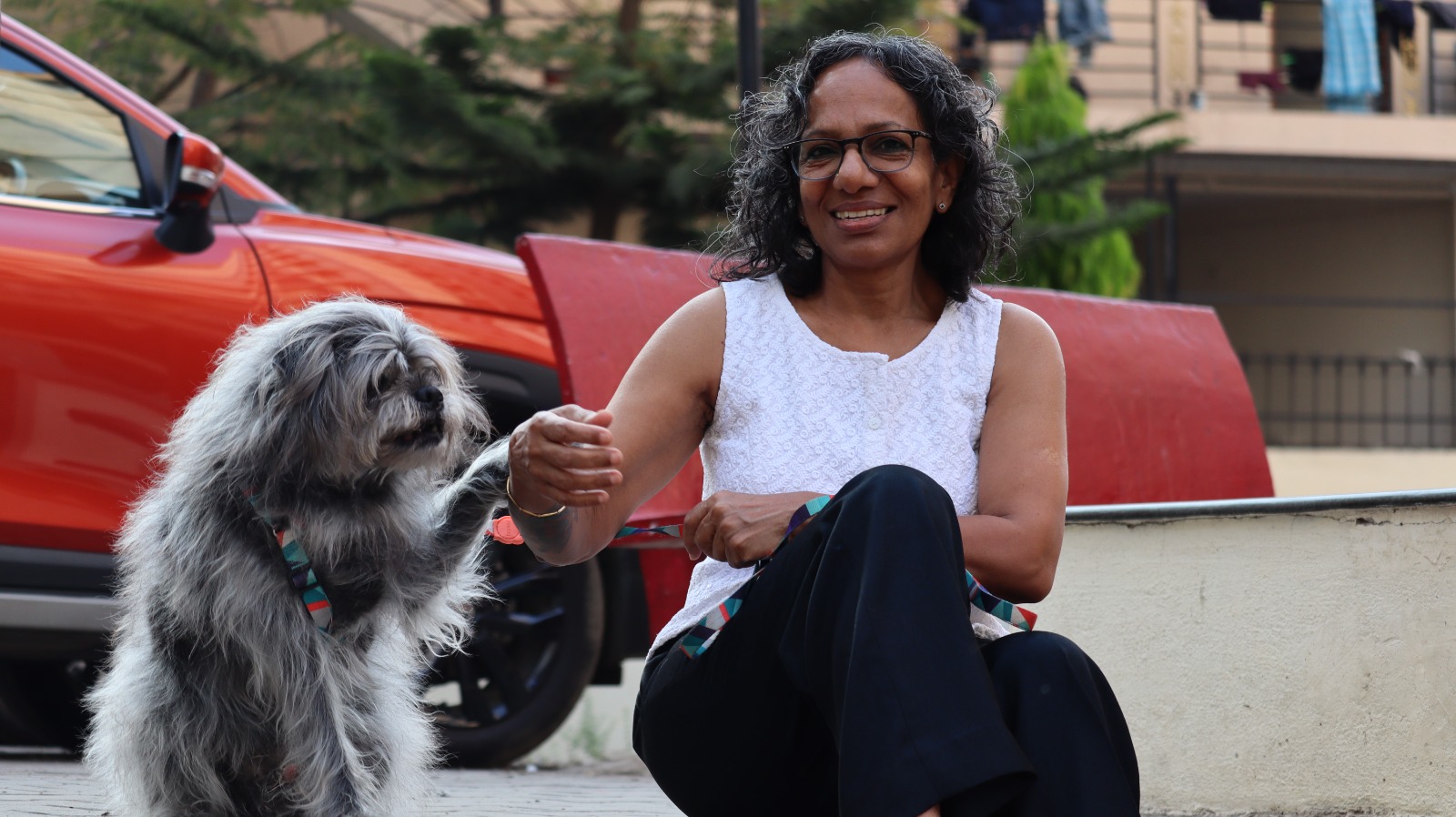
In Boundary Commissions, poet Kala Krishnan approaches love not as confession but as cartography. Drawing on the ancient traditions of Sangam poetry and the structure of classical ragas, she examines modern relationships through the language of borders, crossings, distances and negotiations. The collection offers a distinctly Indian poetic framework for understanding romance, one that is at once intellectually rich and emotionally resonant.
In this conversation with BookShotsApp, Krishnan reflects on uncertainty as a way of living, the creative power of longing, the delicate balance between intimacy and distance, and why writing for her is less about healing wounds than navigating storms. She also speaks about the enduring pull of romance, the transformations wrought by love, and the role of language in making sense of both.
BookShotsApp: These poems feel less like observations about love and more like lived experiences that have been distilled over time. While writing Boundary Commissions, were there memories or relationships you had to revisit that you would rather have left untouched?
Kala Krishnan : You’d say the same about my fiction: that it seems like something I’ve lived. I tend to inhabit what I’m writing, cohabiting with my characters, exploring its topography, participating in its the events. Perhaps the reason these poems seem more compellingly to have grown from a lived life is the topic matter: love and romance. Maybe it’s something we’d like to biograph, to make ‘real’.
BookShotsApp: Your poems often dwell in uncertainty instead of resolution. Do you think you’ve made peace with uncertainty in love, or are you still trying to understand it through poetry?
Kala Krishnan : I have a long-lasting fondness for uncertainty. Certainty, in most of its versions, makes me nervous. It feels artificial, stifling: cosmologies, mythologies, philosophies and our living all seem to me to be uncertain. I think literatures underscore uncertainty. I find great affirmation in uncertainty. It seems to cheer a constant re-configuring. But that isn’t to say that one doesn’t suffer in the uncertainties of love.
BookShotsApp: There’s a remarkable restraint in the book—so much is felt, yet so little is explicitly stated. What emotions were hardest to hold back while writing these poems?
Kala Krishnan : The version that’s in the book, is very different from what it was in the writing. The function of these poems in their first versions, was to companion me through an extended period of concentrated writing—of my first two collections of poetry, and the mythological fiction books—and solitude. They were not written as poetry, not edited, not corrected. The re-work on these poems was almost like a first draft, in back-motion: starting with ‘finished’ pieces, and instilling into them the considerations of writing to be read.
BookShotsApp: The collection returns again and again to distance—emotional, physical, even imagined. Have you ever experienced a relationship where the distance itself became more powerful than the relationship?
Kala Krishnan : I wouldn’t say ‘more powerful’ but yes, certainly I’ve experienced relationships where physical distance was a powerful aspect of the relating, tinging meetings with a rush, adding flair to the vocabulary of the romance.
BookShotsApp: Sangam poetry often understands longing as something almost sacred. Do you think longing can sometimes sustain a relationship more deeply than fulfilment can?
Kala Krishnan : Longing has traditionally been imagined as the animating aspect of love, what keeps it alive and moving. Think Ibn Arabi’s ‘Oh Lord, do not nourish me with love, but with the desire for love.’ or Rumi’s ‘Do not seek for water. Be thirsty.’ Longing is the wings of love and perhaps fulfilment is its home. Is longing the noun—vast, pervading—and fulfilment the actionable part, the verb that demands specificity? The two do seem coupled, like both are necessary to sustain a relationship.

BookShotsApp: Was there a poem in this collection that frightened you to publish because it revealed too much of your inner life?
Kala Krishnan : No, not really. Biographical details, if there were any, would have frightened me with their seductive potential to tantalise (titillate?) readers and readership and perhaps affect sales! I think my hope in revealing my inner life, is that readers will see there, my fascination and commitment to language and craft, two things that I can be rather evangelical about.
BookShotsApp: Love in these poems is never presented as possession; it’s closer to negotiation, surrender, and rediscovery. Has your understanding of love become more complicated or more compassionate as you’ve grown older?
Kala Krishnan : No, neither of those. The boundaries have extended and become less proscribed. But then and now, to quote a line from the collection, ‘Love’s madness is air; indeed air is love’s madness.’
BookShotsApp: The title suggests borders that are constantly being drawn and erased. Looking back at your own life, what emotional boundary took you the longest time to cross?
Kala Krishnan : Almost certainly the boundary where one stops, unable to or not wanting to risk speaking of the transformation that the lover somehow co-works. In that liminal space, it seems to me, we stand and measure independence against the melting and re-forming of the self, in love.
BookShotsApp: Many writers say every book leaves a wound or heals one. When you finished Boundary Commissions, what had changed inside you?
Kala Krishnan : For me, writing has not been about wounds and/or healing, almost never. It is a storm that tosses me overboard and leaves me to be inventive and not drown. What changed after Boundary Commissions was finished, was my attitude to the writing–it went from being a casual nod to individual writing aids, to becoming a more decorous respect for a body of collected poems.
BookShotsApp: If you could sit across from the person—or the feeling—that quietly haunts these poems, what would you say now that you couldn’t say then?
Kala Krishnan : The ‘haunting’ is perpetual: I am susceptible to romance, the feeling of romance, whether in the person of a man, or in the presence of language! But to this person, this man, the musician in the poems, very little remains unsaid; of those, I imagine I might want to say “Let’s collaborate formally; let us craft together, let us be artistic, in addition to being artful.’
