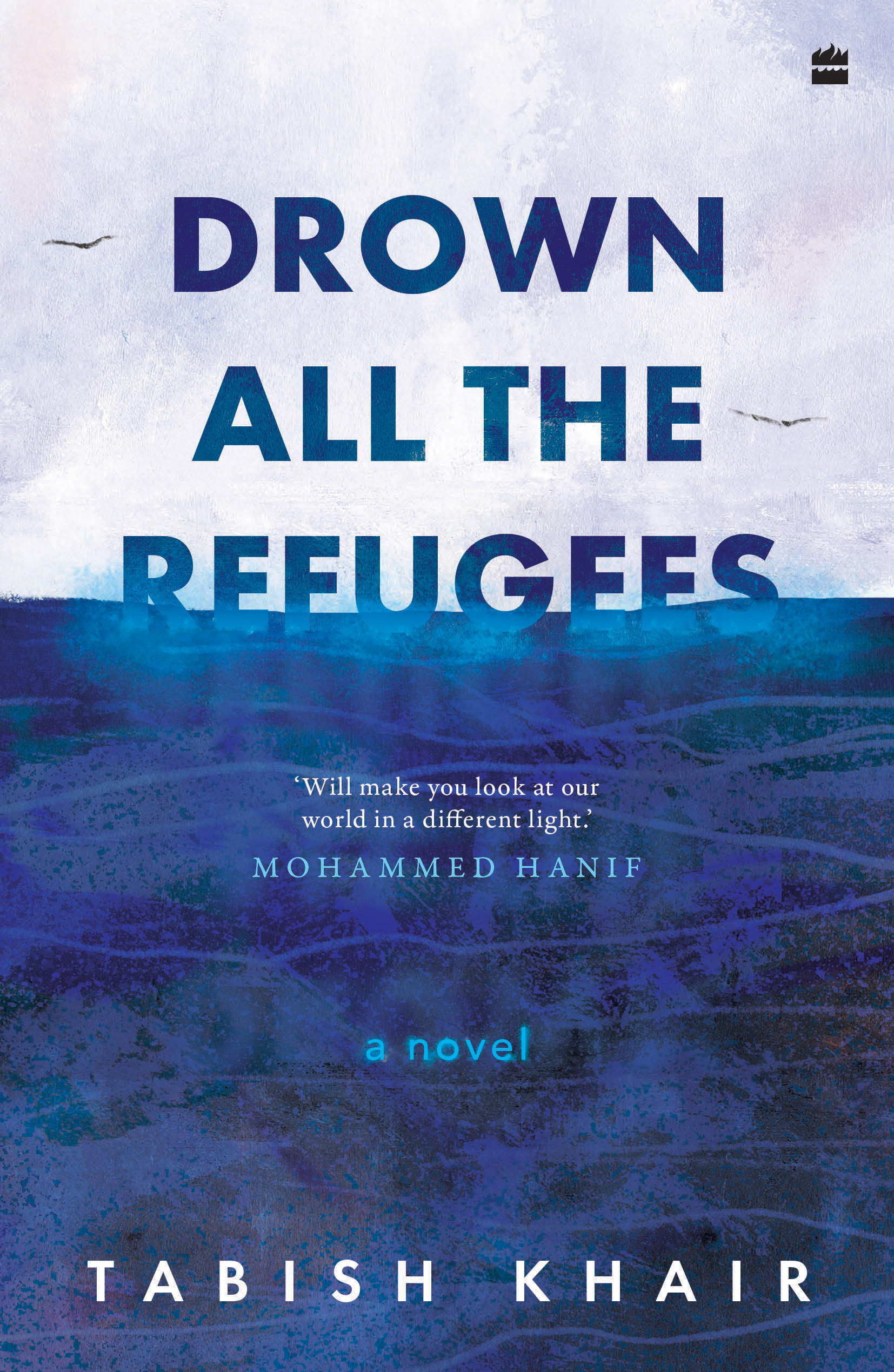
What happens after someone disappears across a border? We often hear stories about those who leave in search of safety or a better life, but far less about the people they leave behind—the mothers who continue to wait, the childhood friends who keep asking unanswered questions, and the memories that refuse to fade. In Drown All the Refugees, Tabish Khair turns his gaze towards these forgotten lives, crafting a novel that is at once intimate, unsettling, and profoundly humane.
Despite its deliberately shocking title, this is not a book built on outrage. It is a deeply reflective exploration of migration, memory, grief, and belonging, wrapped in the eerie atmosphere of Gothic fiction. Rather than offering easy answers or moral certainties, Khair invites readers into a world where every loss leaves a shadow and every return comes with a cost.
The novel opens with the narrator recalling Maria, the woman who worked as his childhood nurse and house-help. Khair introduces her not through dramatic events but through small, vivid details—her weathered hands, practical clothes, quiet dignity, and the silver crucifix she wears around her neck. Maria immediately feels real. She is one of those ordinary people whose lives rarely make headlines, yet whose stories quietly carry the emotional weight of history. Through her, Khair establishes the deeply personal lens through which the novel unfolds.
Maria’s son Pedro, the narrator’s childhood companion, becomes the emotional heart of the story. Driven by the hope of a better future, Pedro crosses borders illegally, leaving behind not only his home but also the people who loved him. Alongside Pedro’s absence is the memory of Abdul, the narrator’s Palestinian boyfriend, whose death adds another layer of grief to an already fragile narrative. Together, these intertwined stories shift the focus away from migration itself and towards its aftermath—the silence, uncertainty, and longing that remain long after people disappear.
One of the novel’s most striking achievements is its unusual blend of literary fiction and Gothic horror. When Maria turns to the occult in a desperate attempt to bring her missing son back, the narrative enters unsettling territory. But Khair never uses the supernatural merely for suspense. Instead, it becomes a powerful metaphor for trauma and irreversible change. The Pedro who returns is no longer the spirited young man his mother remembers but someone hollowed out by experiences too painful to articulate. In that transformation lies one of the novel’s most haunting truths: some journeys leave people alive but forever altered.
Khair handles complex political themes with remarkable restraint. The novel never reduces its characters to symbols or arguments. Refugees are not idealised, nor are they presented simply as victims. Instead, Khair explores the human consequences of displacement from multiple perspectives, reminding readers that migration is not just about crossing borders—it is also about fractured families, interrupted childhoods, and identities reshaped by violence and loss.
The writing itself is one of the novel’s greatest pleasures. Khair’s prose is elegant without being ornate, reflective without becoming self-indulgent. He has a rare ability to transform everyday memories into moments of quiet revelation. Childhood friendships, family histories, religion, class, and belonging all emerge naturally through conversations and recollections, making the novel feel lived rather than constructed. There is an emotional honesty to the storytelling that allows readers to connect deeply with its characters.
The atmosphere throughout remains quietly haunting. Instead of relying on dramatic twists, Khair builds tension through memory, silence, and the things left unsaid. The Gothic elements deepen this mood, creating a lingering sense of unease that mirrors the emotional lives of the characters. Vikram Nayak’s illustrations, accompanying the text, further enrich this haunting quality, adding visual depth to an already immersive reading experience.
Perhaps the novel’s greatest strength lies in its refusal to offer comfort. There are no simple resolutions because the realities it explores rarely have any. Instead, Drown All the Refugees asks readers to confront difficult questions about displacement, identity, and the invisible scars that conflict leaves behind. It is as much about those waiting at home as it is about those who leave.
In a literary landscape where migration is often treated through political debate or humanitarian discourse, Tabish Khair chooses a more intimate path. He writes about memory instead of statistics, grief instead of ideology, and ordinary lives instead of grand narratives. The result is a novel that feels both deeply personal and universally relevant.
Drown All the Refugees is a beautifully written, emotionally resonant novel that challenges conventional narratives around migration and exile. By weaving together literary fiction, Gothic horror, and deeply observed human relationships, Tabish Khair creates a story that is haunting without being sensational, political without being polemical, and profoundly compassionate throughout. It is a novel that lingers—not because it offers answers, but because it asks questions that stay with the reader long after the final page.
