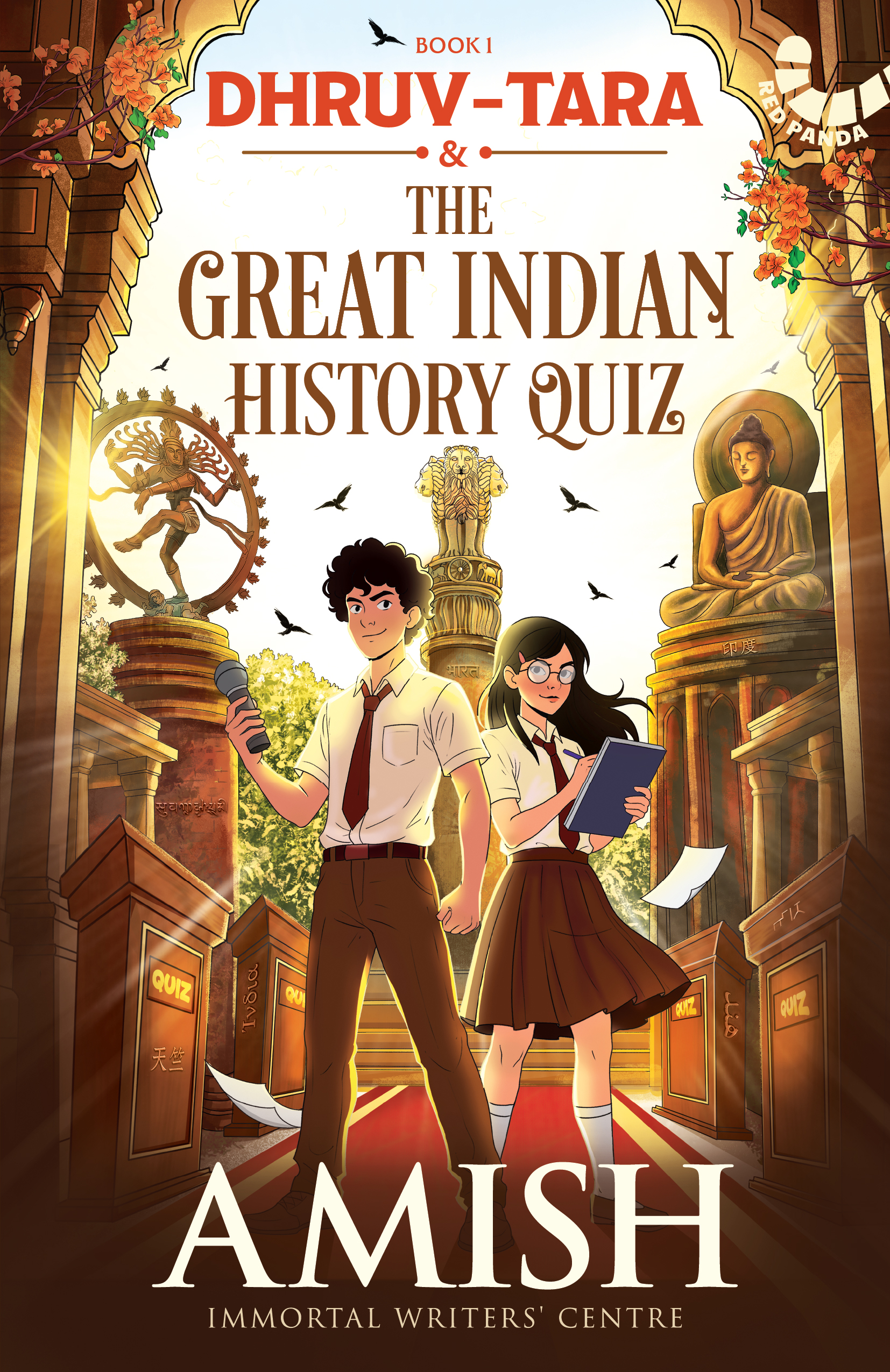
Amish Tripathi reinvents himself with a spirited children’s adventure that transforms history into an engaging quest for discovery
For over a decade, Amish Tripathi has been synonymous with mythological fiction. His novels have reimagined ancient epics for contemporary readers, turning gods into relatable heroes and making Indian mythology a mainstream literary phenomenon. With Dhruv-Tara & The Great Indian History Quiz, however, the bestselling author ventures into completely new territory. Instead of warriors, kings and divine legends, he introduces readers to classrooms, quiz competitions and two spirited schoolchildren. The shift may seem unexpected, but it reveals another side of Tripathi as a storyteller—one who wants to inspire curiosity before anything else.
The book, the first in a planned seven-part middle-grade series, follows Dhruv and Tara, two academically gifted but fiercely competitive classmates who find themselves representing their school in India’s biggest history quiz. Their partnership begins reluctantly, with rivalry overshadowing cooperation. As the competition grows more challenging, the pair embark on a journey that stretches far beyond conventional textbooks. They encounter forgotten stories, remarkable personalities, ancient centres of learning and intriguing mysteries that gradually reshape not only their understanding of history but also their relationship with one another.
What distinguishes Dhruv-Tara & The Great Indian History Quiz is that it refuses to treat history as a collection of dates and dynasties. Instead, it presents the past as something alive, dynamic and worth exploring. Every challenge the protagonists face becomes an opportunity to uncover another layer of India’s civilisational heritage. Rather than relying on lengthy historical explanations, Tripathi embeds information naturally within the narrative, allowing young readers to absorb facts while remaining immersed in the adventure.
This narrative approach is perhaps the novel’s greatest achievement. Many books that attempt to educate young readers struggle to strike a balance between information and entertainment. Too much emphasis on learning risks making the story feel like an extension of the classroom, while excessive adventure often reduces historical content to decorative background. Tripathi manages to maintain an engaging equilibrium. The historical references enrich the plot instead of interrupting it, and the mystery keeps the momentum alive from one chapter to the next.
The central relationship between Dhruv and Tara is equally compelling. Both characters are intelligent, ambitious and determined to prove themselves, yet their strengths lie in different areas. Their contrasting personalities generate moments of conflict, humour and gradual understanding. Instead of creating conventional heroes, the author allows them to make mistakes, challenge each other and slowly discover the importance of trust and teamwork. Their evolving friendship becomes the emotional anchor of the novel, making the story about much more than winning a quiz competition.
Tripathi also deserves credit for recognising what captures the imagination of today’s young readers. The narrative is fast-paced, conversations are lively and the chapters move quickly without sacrificing clarity. The inclusion of illustrations further enhances the reading experience, making the book approachable for middle-grade readers while complementing the storytelling. Even children who may not ordinarily gravitate towards books on history are likely to find themselves drawn into the unfolding adventure.
Beneath the entertaining surface lies a larger objective. Throughout the novel, the author encourages readers to question accepted narratives, remain curious and look beyond familiar accounts of India’s past. The book introduces several lesser-known historical figures and cultural traditions that rarely find adequate space in mainstream school curricula. Instead of presenting history as fixed knowledge to be memorised, it portrays the subject as an ongoing exploration driven by questions, evidence and discovery.
The author’s passion for historical research is clearly reflected in the novel. Historical references are carefully woven into the story, and readers interested in exploring further are provided with detailed sources. This attention to research adds credibility to the narrative while signalling that fiction and factual inquiry can comfortably coexist. Young readers are encouraged not merely to accept what they read but to investigate further—a valuable lesson in an age where information is readily available but critical thinking is increasingly important.
At the same time, Dhruv-Tara & The Great Indian History Quiz is not without an underlying ideological perspective. The novel reflects Tripathi’s belief that Indian history deserves to be revisited through fresh lenses and that younger generations should engage more deeply with their cultural heritage. Readers may agree or disagree with some of the broader historical interpretations suggested through the narrative, but the book succeeds in opening conversations rather than closing them. That willingness to provoke curiosity may ultimately be one of its greatest strengths.
Another noteworthy aspect is Tripathi’s confidence in stepping outside the genre that established his literary reputation. Writing for children requires restraint, simplicity and a different rhythm from adult fiction. Rather than relying on the grand philosophical discussions or elaborate world-building that characterise many of his earlier works, he embraces concise storytelling driven by action, humour and relatable characters. The transition feels remarkably natural, suggesting that his storytelling instincts adapt comfortably to a younger audience.

Perhaps the book’s most significant achievement is that it reminds readers that learning need not be separated from enjoyment. In an era when children spend increasing amounts of time on digital devices, creating books that compete for their attention is no easy task. Dhruv-Tara & The Great Indian History Quiz understands this challenge. It delivers puzzles, suspense, friendship, humour and adventure while quietly nurturing an interest in history. It entertains first and educates almost effortlessly.
As the opening chapter of what promises to be a long-running series, the novel leaves enough unanswered questions to build anticipation for future instalments. More importantly, it establishes characters whose journeys readers will likely want to follow. If the subsequent books continue to blend historical exploration with engaging storytelling, the series could become an important addition to contemporary Indian children’s literature.
