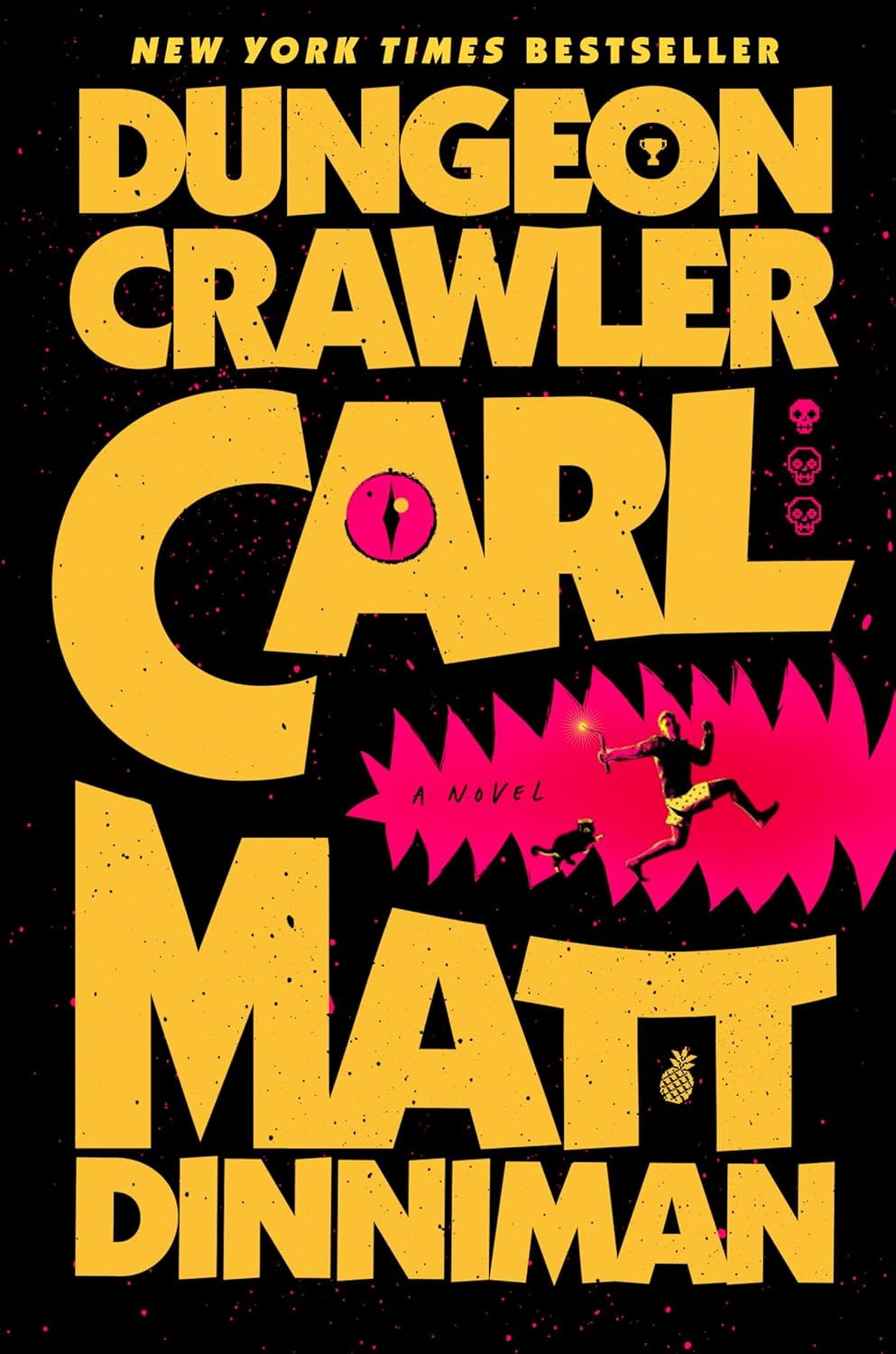
There’s a certain kind of book that doesn’t ask for your approval—it grabs you by the collar and drags you into its world. Dungeon Crawler Carl is very much that kind of experience. It is loud, strange, frequently ridiculous, and far more clever than it first appears.
The setup is pure chaos. Earth is wiped out in an instant, its survivors herded into a sprawling, trap-filled dungeon that doubles as a reality show for an alien audience. The rules are simple enough: go in and play, or stay out and die. Carl, caught at the worst possible moment, chooses the obvious option—though “choice” hardly feels like the right word. Accompanying him is Princess Donut, a show cat with a newly acquired voice and a personality that refuses to be ignored. What begins as an odd pairing quickly becomes the heart of the story.
Dinniman doesn’t waste time explaining too much. Instead, he throws the reader straight into the mechanics of this world—levels, achievements, loot, monsters—letting the logic of the dungeon reveal itself as the story unfolds. The pacing mirrors a video game: fast, relentless, always pushing forward. Just when things seem to settle, something explodes, mutates, or turns unexpectedly lethal.
But the book’s real hook lies in how it treats all this mayhem. The dungeon isn’t just a battlefield; it’s a broadcast. Every move Carl makes is being watched, judged, and, above all, consumed as entertainment. Survival depends not just on skill, but on staying interesting. It’s here that the novel quietly sharpens its edge. Strip away the aliens and the monsters, and what remains feels uncomfortably familiar—a world where attention is currency and performance becomes a form of survival.
The humour plays a big role in keeping the story from collapsing under its own brutality. It’s irreverent, often absurd, and occasionally dark in a way that catches you off guard. Princess Donut, in particular, is more than a gimmick. She’s vain, sharp-tongued, and unexpectedly capable, bringing a kind of unpredictable energy that keeps the narrative from becoming too mechanical.
That said, the book isn’t without its rough edges. The LitRPG style—complete with constant updates, achievements, and system notifications—can feel repetitive over time. For readers unfamiliar with gaming culture, these elements might even prove distracting. The story occasionally lingers too long on its own mechanics, slowing the momentum it works so hard to build.
Even so, it’s difficult to deny the book’s momentum. Dinniman has created a world that thrives on escalation, where each level feels stranger and more dangerous than the last. There’s a sense that anything can happen—and often does.
What lingers after the final pages isn’t just the spectacle, but the idea behind it. Dungeon Crawler Carl understands something about the age we live in: that the line between reality and performance is thinner than we like to admit, and that audiences—whether human or alien—have an insatiable appetite for both.
This isn’t a quiet, reflective novel. It’s messy, energetic, and unapologetically entertaining. But beneath the noise, there’s a sharp awareness of what it’s doing—and why it works. Once you step into the dungeon, it’s surprisingly hard to step back out.
