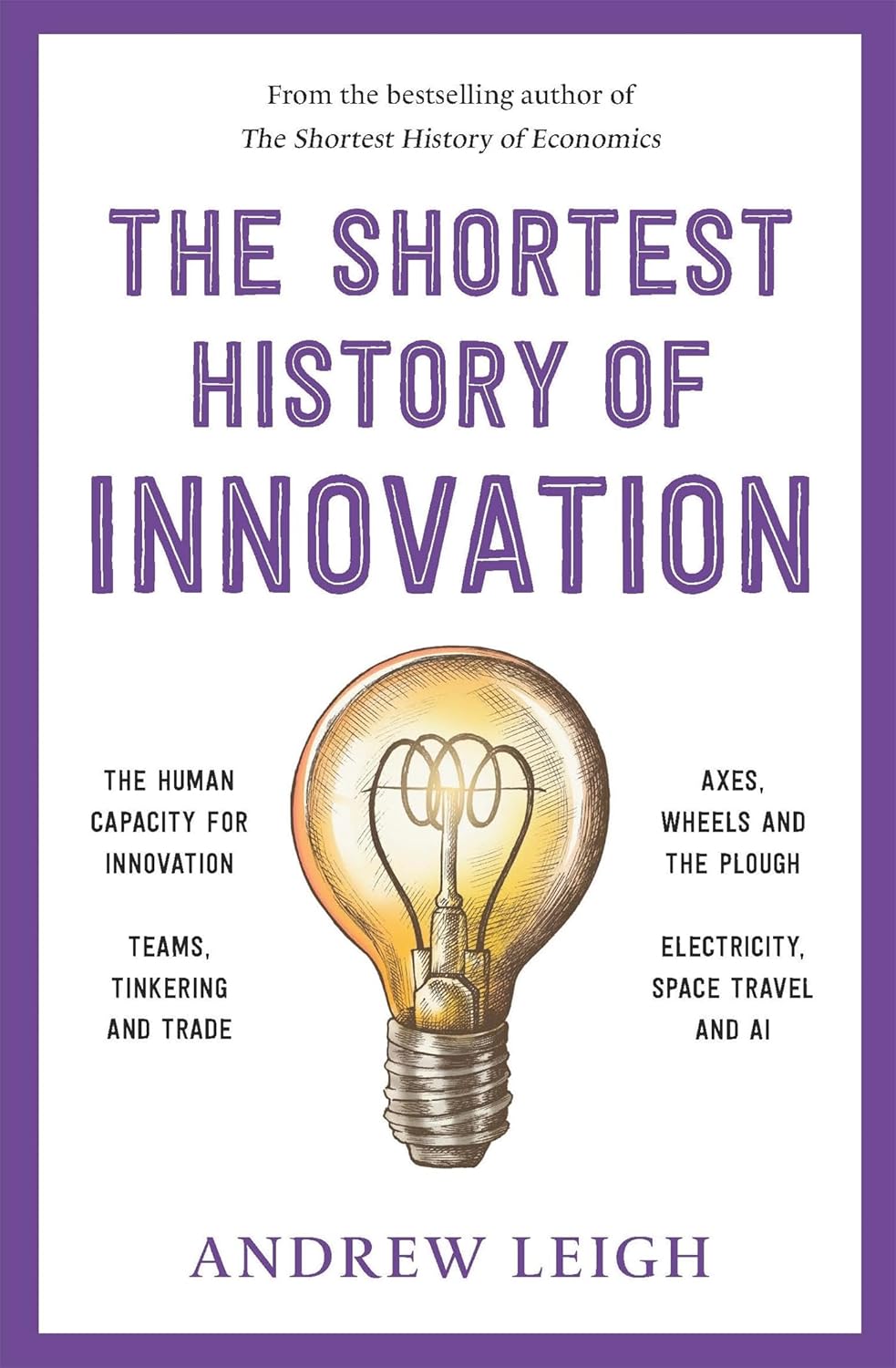
It’s easy to think of innovation as something dramatic—big breakthroughs, cutting-edge technology, moments that change the world overnight. Andrew Leigh’s The Shortest History of Innovation takes a quieter, more interesting view. It reminds us that progress is just as often built on small, practical ideas—the kind we use every day without a second thought.
Leigh moves comfortably across time, from early inventions like the wheel to today’s developments in artificial intelligence. What ties it all together is his focus on three simple forces: tinkering, teams, and trade. It’s a neat framework, and more importantly, it works. You begin to see how experimentation, collaboration, and the exchange of ideas keep showing up behind almost every major shift in human history.
One of the book’s strengths is its eye for the overlooked. Leigh spends time on things that rarely get attention—buttonholes, tin cans, windscreen wipers—and shows how much thought and trial went into them. These details give the book a certain warmth. Innovation doesn’t feel distant or technical; it feels human, shaped by curiosity and necessity in equal measure.
The writing is clear and brisk, which suits the format. True to its title, the book doesn’t linger too long in any one place. At times, you might wish it did—some examples feel like they could have been explored in more depth. But there’s also something satisfying about the pace. It keeps the narrative moving and makes the connections between past and present feel immediate.
Leigh also touches on the conditions that allow innovation to flourish—or hold it back. The role of open societies, the movement of people and ideas, and the importance of collaboration all come through without feeling heavy-handed. There’s an underlying argument here, but it’s woven in lightly.
What stays with you after reading is a shift in perspective. Innovation stops being a series of isolated breakthroughs and starts to look more like an ongoing conversation—one that stretches across time, shaped by countless contributors.
The Shortest History of Innovation doesn’t try to be exhaustive. Instead, it offers a sharp, engaging overview that leaves you noticing the world around you a little differently—and perhaps with a bit more appreciation for the ordinary things that quietly changed everything.
