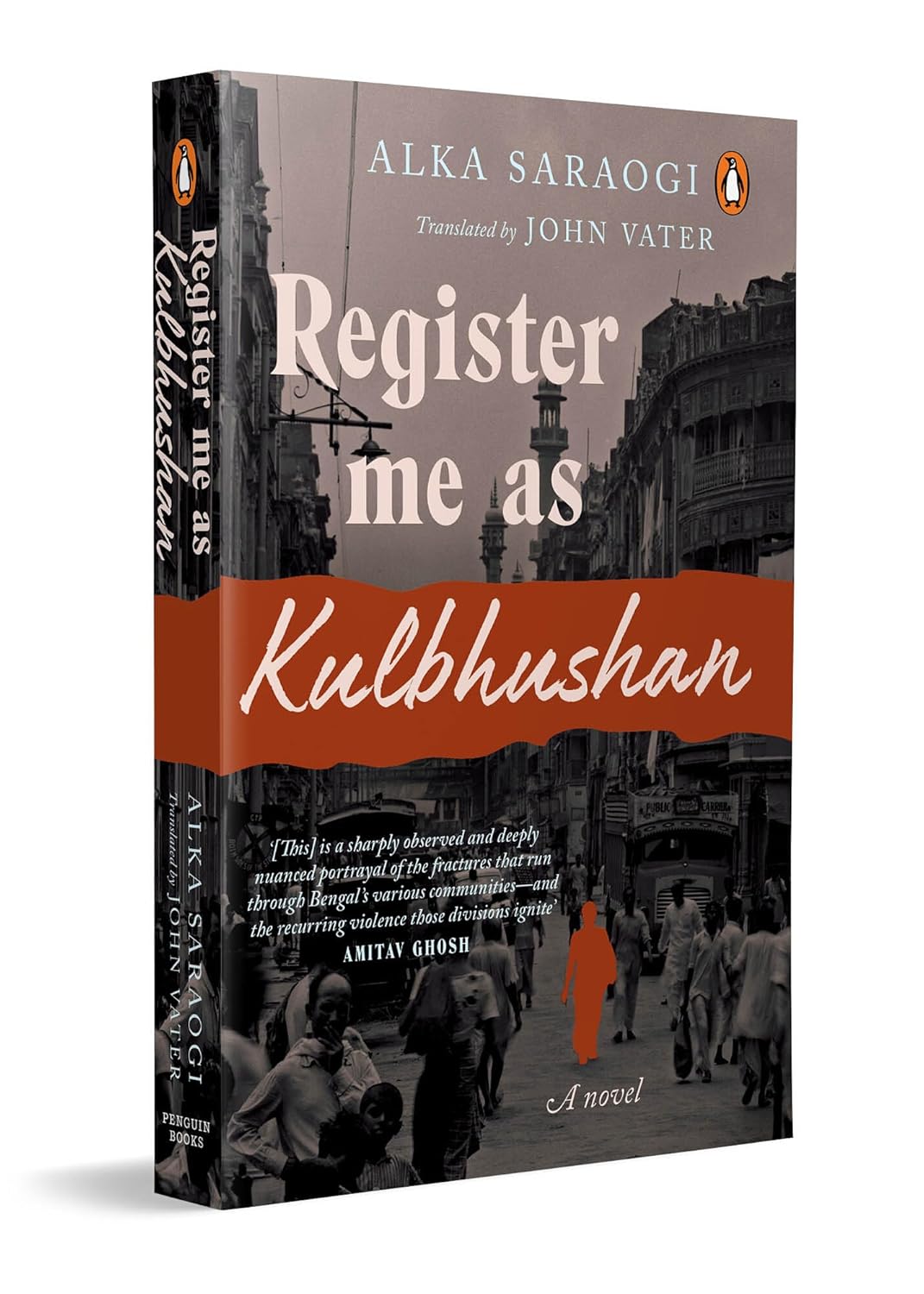
Alka Saraogi’s Register Me as Kulbhushan, translated by John Vater, presents a deeply layered narrative set against the shifting socio-political landscape of Bengal and the aftermath of the 1971 Bangladesh Liberation War. Through a story rooted in displacement and reinvention, the novel examines how identity is shaped—and sometimes erased—by history.
At the heart of the novel is a man known by many names—Kulbhushan Jain, Gopal Chandra Das, and Bhushan Chacha—who wanders through Kolkata in search of recognition and belonging. His fragmented identity reflects a life marked by migration and the constant negotiation between past and present.
A central motif in the narrative is the idea of a “button of forgetting,” a phrase taught to him by his childhood friend Shyama Dhobi. This coping mechanism allows him to momentarily escape painful memories, but as the story unfolds, it becomes clear that forgetting comes at a cost—the gradual erasure of personal history and selfhood.
Parallel to his journey runs Shyama’s own story, tracing his rise from a washerman to a trusted figure within elite Bengali households. His life, too, becomes entangled in larger political currents, particularly during the upheavals leading up to the Bangladesh Liberation War. Together, their intertwined narratives offer a cross-border account of migration, aspiration, and survival across India and East Pakistan.
Blending philosophical reflection with a wry narrative tone, the novel captures Kolkata as a living, breathing migrant city—one shaped by arrivals, departures, and layered histories. It also underscores fiction’s role as a form of documentation, reconstructing lives that often remain absent from official records.
The book revisits the long-term human consequences of the 1971 war, moving beyond conventional historical accounts. It interrogates the instability of identity under social and political pressure and explores memory as both refuge and burden. By foregrounding marginal lives, it turns storytelling into an act of preservation.
Alka Saraogi, a Kolkata-based Hindi writer and Sahitya Akademi Award winner, is known for her nuanced portrayal of the Marwari diaspora. With multiple novels and short-story collections to her credit, her work has been widely translated and internationally recognised.
The English translation is by John Vater, an American writer and Fulbright–Nehru scholar, whose work has appeared in leading literary journals such as Ploughshares and Words Without Borders.
Writers Amitav Ghosh and Geetanjali Shree have praised the novel for its nuanced depiction of social fractures and its poignant portrayal of lives shaped by violence, displacement, and inequality.
