Writing a single-volume history of India has become an increasingly difficult undertaking. Over the past few decades, historical scholarship has expanded far beyond conventional political narratives to include histories of caste, gender, environment, labour, regional cultures, migration, religion, language and communities long left outside mainstream accounts. The question many historians now ask is whether one coherent “history of India” can still be written at all.
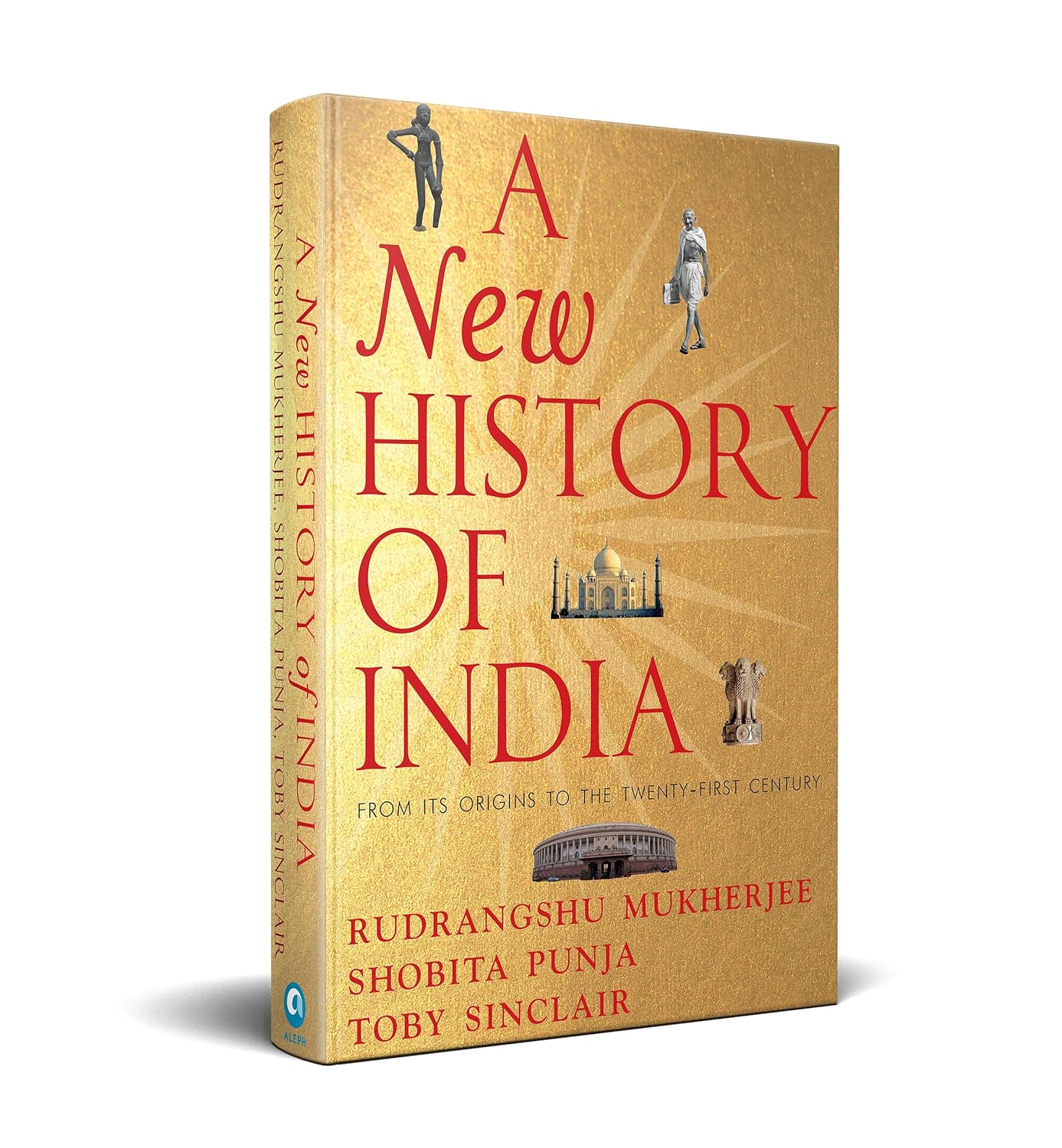
In A New History of India: From Its Origins to the Twenty-First Century, historians Rudrangshu Mukherjee and Shobita Punja, along with photographer and archivist Toby Sinclair, attempt exactly that. Stretching from the geological formation of the subcontinent to contemporary India, the book seeks to condense thousands of years of political, social and cultural transformation into a richly illustrated single volume.
It is an ambitious project, and for large parts, an engaging and accessible one.
The book opens not with kings or empires, but with geology and migration, tracing the formation of the Indian landmass and the arrival of early humans into the region. From there, it moves through the Harappan civilisation, Vedic society, Buddhism and Jainism, the Mauryas, Guptas, Delhi Sultanate, Mughals, colonial rule, the freedom struggle and the making of the modern republic.
Alongside political history are discussions on caste, religion, philosophy, architecture, art, economy and language, giving readers a broad overview of the forces that shaped the subcontinent over centuries.
One of the book’s greatest strengths is its readability. The prose remains lucid and approachable, avoiding dense academic jargon without oversimplifying historical complexity. The chapters are concise, the pacing brisk and the visual material — maps, archival photographs and illustrations — adds depth and texture to the reading experience. In many ways, the book feels designed for the curious general reader rather than a specialist academic audience.
The collaboration between the three authors also gives the work an unusual texture. Mukherjee’s command over modern Indian political history, Punja’s engagement with culture and heritage, and Sinclair’s visual sensibility together create a narrative that is both informative and visually immersive.
Importantly, the book does make an effort to move beyond the traditional North India-centric approach that dominates many histories of the country. South Indian kingdoms and Tamil society receive meaningful attention, particularly in the earlier sections. A dedicated chapter on the North-East attempts to address a region frequently marginalised in mainstream Indian narratives.
Yet the book is not without its inconsistencies and limitations.
At times, the narrative struggles to reconcile the sheer scale of its ambition with the constraints of a single volume. Questions emerge about what exactly the book wants to be: a political history, a civilisational history, a cultural overview or a people’s history. The shifts between these approaches are not always smooth.
The structure too occasionally feels uneven. While the first half largely follows a chronological flow, thematic chapters appear abruptly in the middle of the narrative. The final quarter of the book becomes heavily focused on colonial Bengal, nationalism and the freedom movement, narrowing the wider panoramic lens established earlier. By the end, the story increasingly resembles a familiar top-down political history centred on the making of the Indian nation-state.
There are also moments where certain assumptions feel dated or insufficiently interrogated. The use of present-day geographical references for historical periods, broad suggestions linking political rule to religious conversion, or reducing Ambedkar’s caste consciousness largely to education rather than lived experience can leave readers wanting more nuance.
The chapter on the North-East illustrates both the strengths and weaknesses of the book. While it commendably foregrounds the region and questions the very term “North-East”, it also slips into a language of cultural distance that unintentionally “others” the region even while trying to include it.
The title itself invites scrutiny. What exactly is “new” about this history? The book synthesises a vast body of existing scholarship rather than presenting radically new archival discoveries or interpretations. Its originality lies less in groundbreaking argument and more in the attempt to present a broad, visually rich and accessible narrative of India’s past for contemporary readers.
And perhaps that is achievement enough.
In a time when history is increasingly contested, fragmented and politicised, A New History of India offers readers a sweeping introduction to the subcontinent’s long and layered past. It may not fully resolve the challenges of writing a singular Indian history in the twenty-first century, but it demonstrates why the attempt still matters.
The result is a book that is sometimes uneven, occasionally frustrating, but consistently thoughtful and undeniably valuable — especially for readers looking for an expansive gateway into India’s complex historical landscape.
