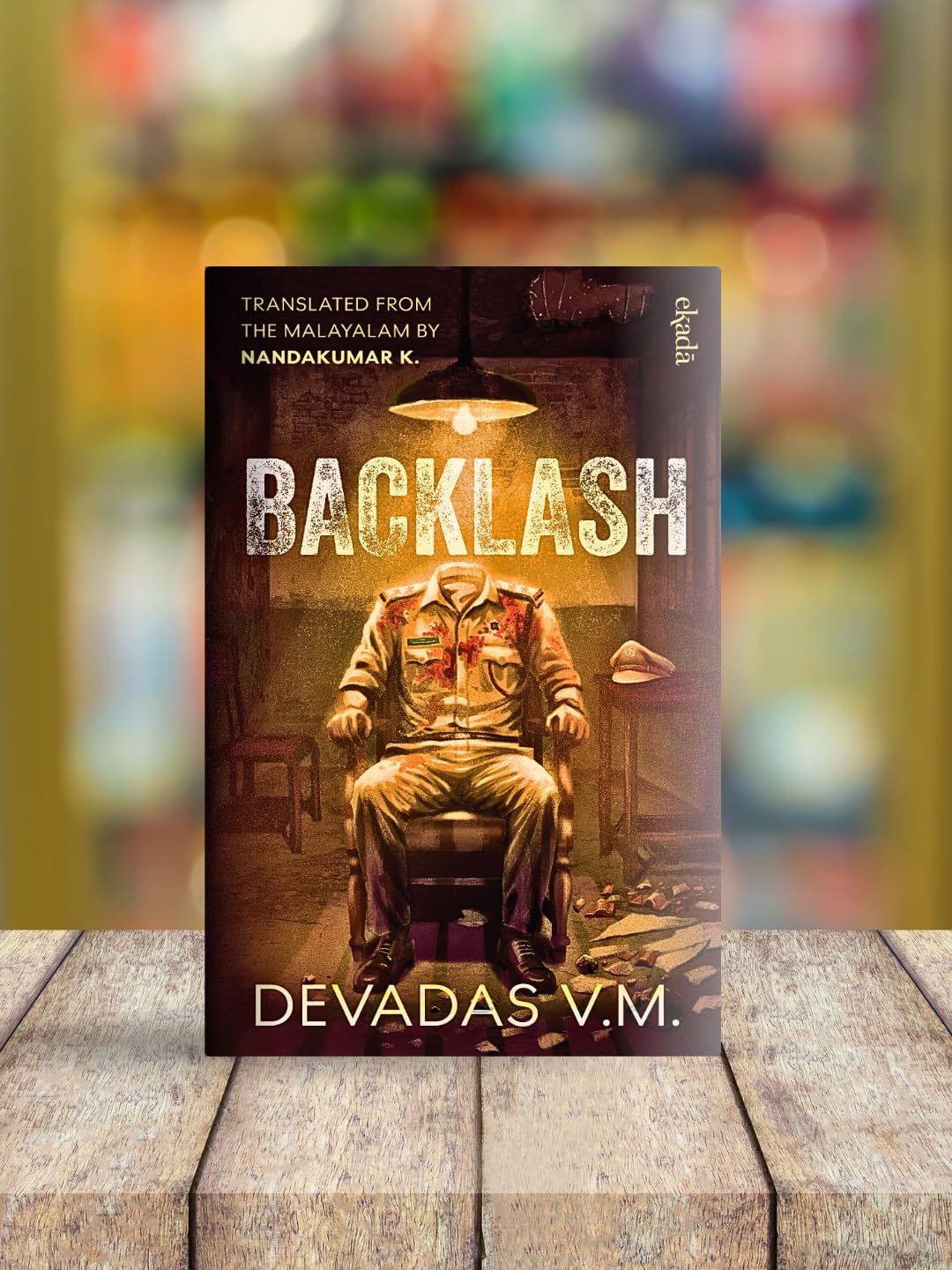
Some novels build suspense around a mystery. Backlash builds suspense around a conscience. Devadas V.M.’s gripping novel, translated from Malayalam by Nandakumar K., is a slow-burning psychological thriller that asks an unsettling question: what happens when the past finally comes knocking at your door?
At its centre is Shreedharan Nair, a retired Kerala police officer who has deliberately chosen the quiet anonymity of village life. But tranquillity proves short-lived. Every night, stones begin crashing onto the roof of his house, turning an ordinary home into a site of dread. Is someone seeking revenge? Is it a supernatural force, as some villagers suggest? Or are these echoes of a lifetime spent wielding authority without accountability?
Once feared as ‘Kaalan Shreedharan’—a chilling nickname invoking Yama, the god of death—Nair embarks on a deeply uncomfortable journey through his own history. He revisits the people he brutalised during his years in uniform, creating a list of victims subjected to the notorious ‘third degree’ methods of custodial violence.
What unfolds is far more than a crime story. Backlash becomes a powerful exploration of guilt, institutional violence and the long afterlife of unchecked power.
Devadas V.M. masterfully weaves together personal memory and national history. The narrative moves through some of India’s most defining and disturbing moments—the Emergency, the Babri Masjid demolition, the rise of religious polarisation, fake encounters and mob violence—not as distant political events, but as forces that seep into ordinary lives and shape individual choices.
The novel’s greatest achievement lies in its refusal to offer easy redemption. Shreedharan Nair is neither a hero nor a villain in the conventional sense. He is a deeply flawed man confronting the consequences of a system that once rewarded brutality and now leaves him alone with its residue.
The writing is sharp, atmospheric and quietly devastating. The suspense never relies on dramatic twists alone; instead, it emerges from an ever-present sense of unease. Every stone that hits the roof feels symbolic—a reminder that violence rarely disappears, even when institutions, governments and people attempt to bury it.
Nandakumar K.’s translation deserves equal praise. He successfully carries the emotional texture and political urgency of the original Malayalam text into English, allowing the story’s intensity to remain intact without losing its regional authenticity.
Beyond its thriller elements, Backlash is a meditation on masculinity and power. It interrogates how institutions create men who are taught to dominate, suppress empathy and equate authority with fear. The result is a novel that feels urgently contemporary, speaking to conversations around state power, accountability and collective memory.
Backlash is not an easy read, nor does it aspire to be. It unsettles, provokes and lingers long after the final page. It reminds us that history is never truly past and that every act of violence leaves behind an invisible debt waiting to be paid.
Dark, intelligent and profoundly relevant, Backlash is a compelling work of contemporary Indian literature that transforms a simple mystery into a haunting examination of a nation and the people who helped shape its scars.
A gripping literary thriller that asks not who committed the crime, but whether anyone can ever escape the consequences of power.
