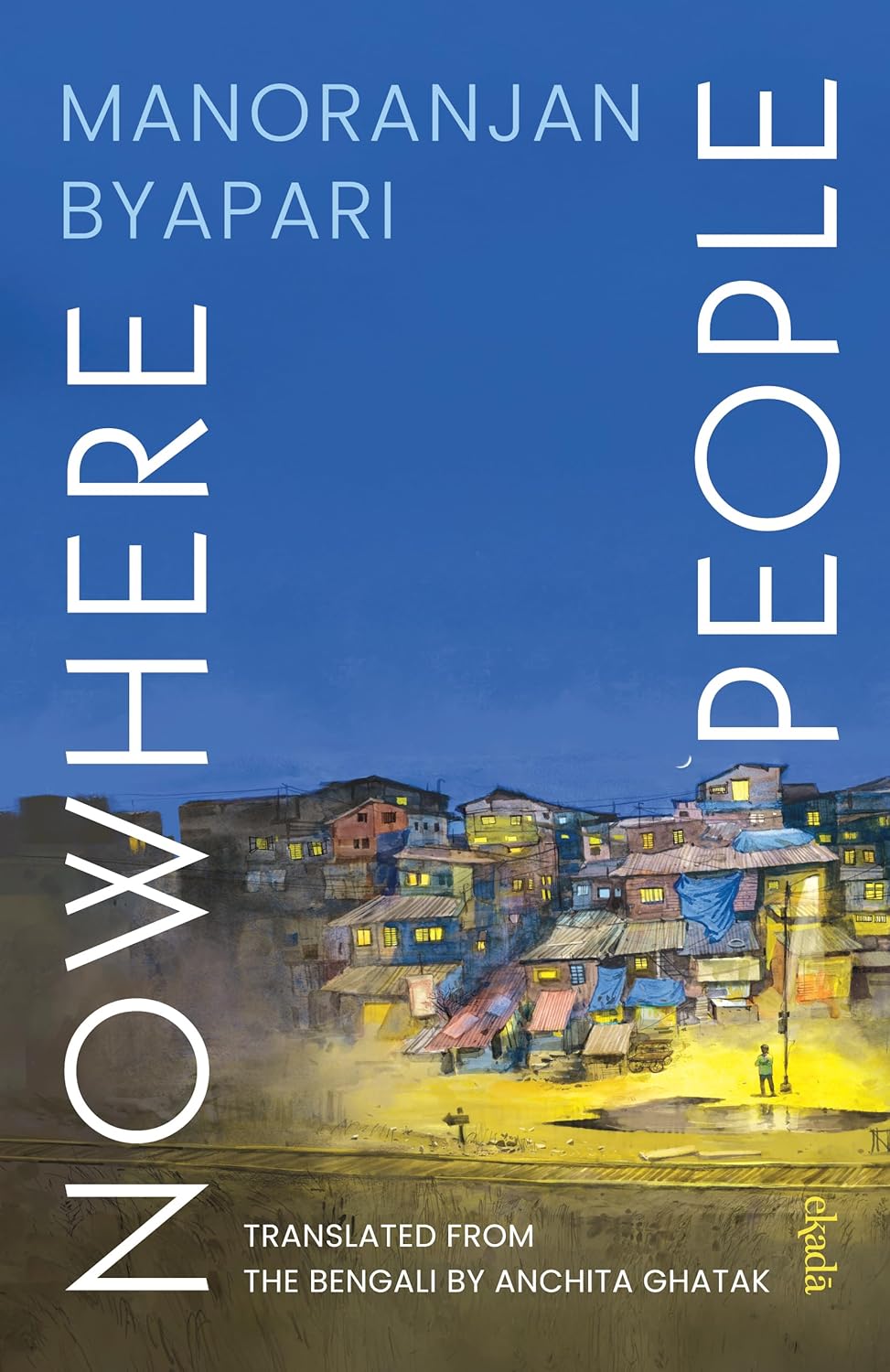
For most of us, railway stations are places of urgency. We rush in, eyes on the clock, minds on our destination. The people who inhabit these spaces—the vendors, the migrant workers, the children slipping between crowds, the men asleep beside their rickshaws—fade into the background. We see them, but rarely do we register them.
Manoranjan Byapari’s Nowhere People disrupts this everyday blindness. Set around Kolkata’s Jadavpur railway station, the novel compels us to look again—more closely, more uncomfortably—at those who live on the margins of the city, yet sustain its everyday rhythm. These are people without fixed addresses, without recognition, and often without names. Platform number two is not just a location; it is their entire world.
Byapari constructs the station as a liminal space—neither fully part of the city nor entirely outside it. Within this in-between world exists a sharp, almost brutal contrast. Platform one, polished and orderly, caters to the more affluent commuter, carrying the sheen of urban aspiration. Platform two, by contrast, is home to rickshaw pullers, migrants, and the dispossessed—the “nowhere people.” The divide between these two spaces is not merely physical; it reflects deeper social, economic, and moral fault lines. As the novel suggests with biting clarity, inequality is not accidental but maintained, even normalized.
The characters who inhabit this world feel deeply real, even when they remain unnamed. And when they are named—Joga, Horen Gosh, Ganjatti Gobindo, Number Ten—the names themselves carry weight, history, and loss. Horen Gosh, for instance, is a man stripped of everything by Partition except his language. Others have lost even their names, acquiring new identities within the rickshaw community. In this world, naming is not just a matter of identity; it is tied to dignity, memory, and belonging. As one character reflects, what use is a name when society refuses to acknowledge your existence?
At the heart of the novel is a young drifter who arrives at the station as an anonymous figure, called different things by different people. It is only when he is taken in by Joga and given the name Nobo that he begins to belong. Through Nobo’s journey, Byapari explores how identity is formed not by birth or documentation, but by relationships and shared struggle.
The rickshaw pullers’ lives are marked by relentless hardship. They work through the day, ferrying passengers across the city, and sleep beside their vehicles at night. Their earnings are barely enough to sustain them—never enough to build a future. Yet, within this scarcity exists a fragile but powerful sense of community. They share what little they have, bound not by blood but by necessity and mutual dependence. As one character puts it, a single stick breaks easily, but a bundle does not.
This sense of collective survival becomes one of the novel’s strongest threads. Byapari repeatedly returns to the idea that those determined to live cannot be easily erased. The resilience of these men—and of the women and children who inhabit this world alongside them—gives the narrative its emotional force. The arrival of an abandoned newborn at the station marks a turning point in the story, especially for Nobo, whose life takes on new meaning as he assumes responsibility for the child.
Beyond its characters, Nowhere People is deeply political without being didactic. Byapari weaves into the narrative the structural realities that produce such lives: the collapse of rural economies, the displacement caused by Partition, the failures of governance, and the systemic exploitation of labour. Hunger—literal and metaphorical—runs through the novel as a recurring motif. It is not just about the absence of food, but about deprivation as a tool of control, a way of preserving social hierarchies.
Anchita Ghatak’s translation deserves special mention for its quiet strength. The prose reads naturally in English while retaining the texture and rhythm of the original Bengali. Local expressions, humour, and emotional nuances are carried across without feeling forced, allowing the story to remain rooted even as it reaches a wider audience.
Nowhere People is not a comfortable read, nor does it try to be. It does not offer easy resolutions or sentimental consolation. Instead, it asks for attention—for a willingness to confront lives we are conditioned to overlook. In doing so, it transforms the railway station from a place of transit into a space of reckoning.
This is not just Nobo’s story. It is the story of countless others who exist in plain sight, sustaining the city while remaining excluded from it. Byapari does not ask us to pity them. He asks us, simply, to see them.
If you want, I can also trim this into a newspaper-length review or give it a sharper editorial tone.
