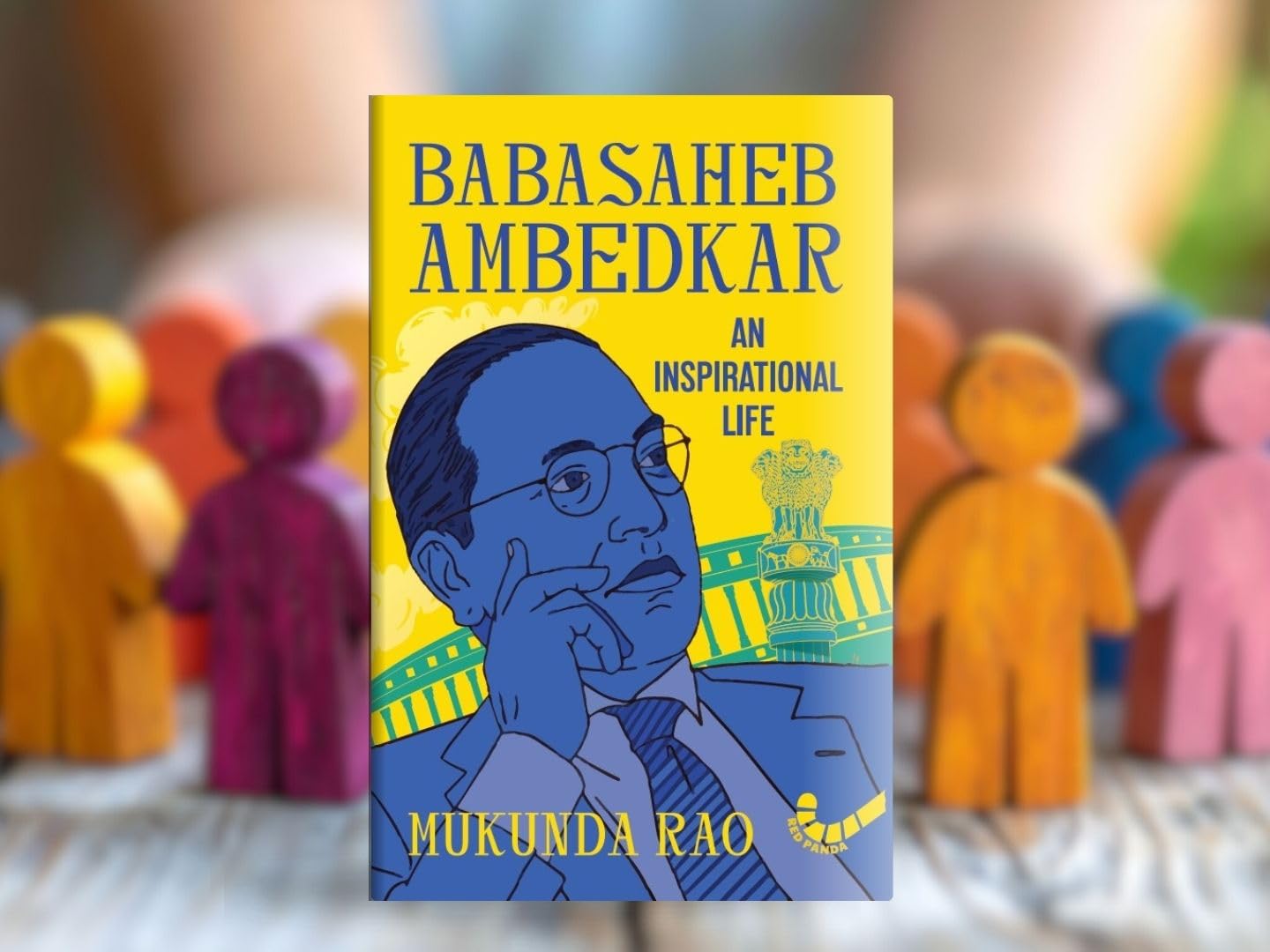
Writing for young readers about a figure as vast and politically contested as B.R. Ambedkar is no easy task. There is always the temptation either to simplify him into a saintly icon or to burden the narrative with ideological weight that obscures the human story. Mukunda Rao, in Babasaheb Ambedkar: An Inspirational Life, largely avoids both traps, choosing instead a quieter, more direct route—one that trusts the power of lived experience to speak for itself.
The book opens with a stark and unforgettable image: a young Bhim, humiliated and cast aside during a journey simply because of his caste. It is a scene that has been recounted in many biographies, but here it is handled with a restraint that makes it all the more affecting. There is no attempt to dramatise suffering beyond what it already is. Instead, Rao lets the moment stand as an early fracture—one that would go on to shape a formidable intellectual and moral resolve.
From there, the narrative traces Ambedkar’s journey with clarity and purpose. What emerges is not just the story of a boy who rose against odds, but of a mind that refused to accept the given order of things. Rao places consistent emphasis on Ambedkar’s education—not merely as personal advancement, but as a deliberate instrument of resistance. This is an important choice, particularly for younger readers, as it shifts the focus from passive admiration to active engagement with ideas.
The language is simple, as it must be for its intended audience, but it is not simplistic. There is an effort to introduce complex themes—caste hierarchy, social exclusion, the idea of justice—without diluting their seriousness. Rao does not gloss over the harshness of the world Ambedkar inhabited, nor does he inflate his struggles into myth. The balance is careful: Ambedkar is neither reduced to a victim nor elevated beyond reach. He remains, throughout, a figure shaped by circumstance but defined by response.
What the book does particularly well is connect Ambedkar’s early experiences to his later role in shaping India’s democratic framework. His work on the Constitution is not presented as an isolated achievement, but as part of a continuum—a logical extension of a lifelong engagement with questions of equality, dignity, and rights. For young readers, this linkage is crucial. It turns history into something coherent rather than episodic.
At the same time, the biography carries an undercurrent of moral instruction, though it rarely feels heavy-handed. The insistence that democracy must go beyond political freedom to include social equality is woven into the narrative rather than stated as a slogan. In this, Rao echoes Ambedkar’s own concerns without turning the book into a lecture.
If there is a limitation, it lies in the very nature of the format. At its length and level, the book can only offer a selective view of a deeply complex life. Certain contradictions, debates, and sharper edges of Ambedkar’s political thought inevitably remain outside its scope. But this is less a flaw than a boundary set by the book’s intended readership.
What remains is a biography that understands its purpose. It introduces Ambedkar not as a distant national figure carved in stone, but as a thinking, striving individual whose life continues to have consequences. For children encountering his story for the first time, this approach is likely to be far more enduring than grand rhetoric.
In the end, Babasaheb Ambedkar: An Inspirational Life succeeds not by overwhelming its readers, but by quietly urging them to ask questions—about fairness, dignity, and the kind of society they wish to inhabit. That, perhaps, is the most fitting tribute to the man it seeks to portray.
